

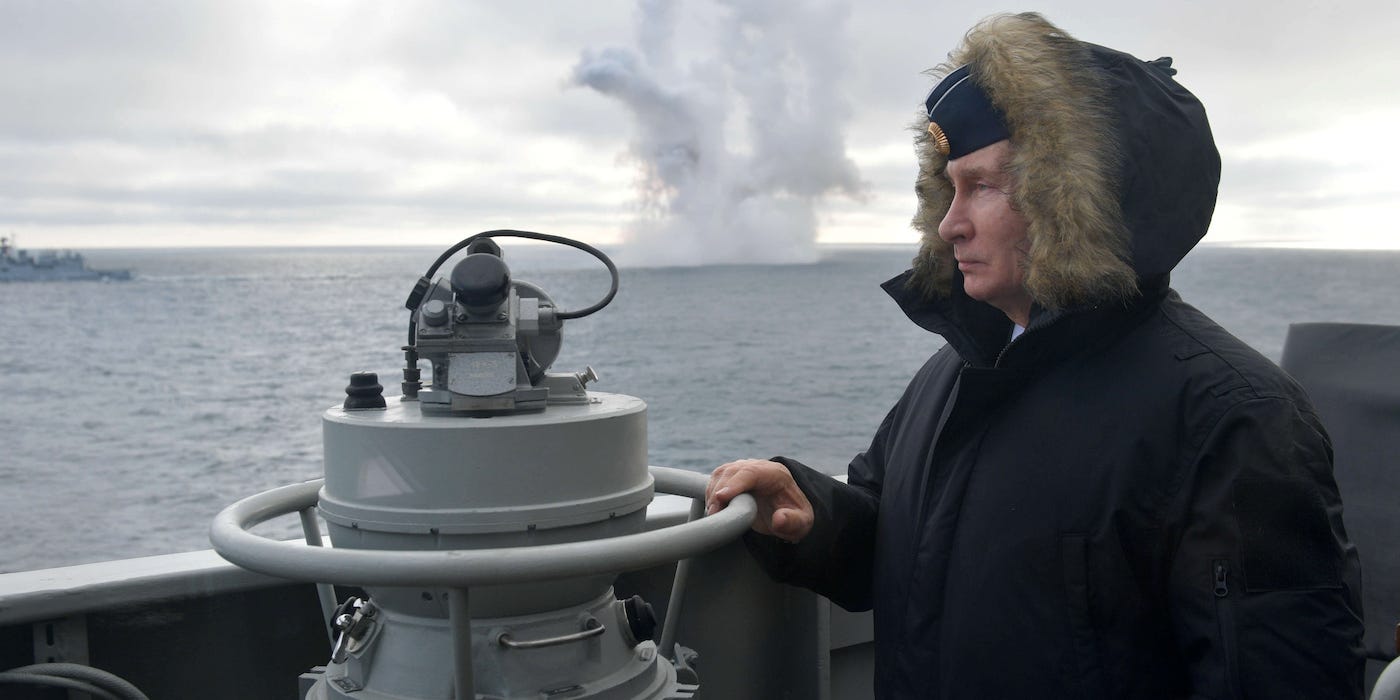
Russian President Vladimir Putin observes naval drills from the guided-missile cruiser Marshal Ustinov in the Crimean port of Sevastopol, Crimea, January 9, 2020.
Sputnik/Alexei Druzhinin/Kremlin via REUTERS
- Russian President Vladimir Putin has again ramped up pressure on Ukraine.
- Putin’s moves harken back to Cold War struggles and serve Russia’s goal of asserting itself as a global power.
- Underpinning Putin’s efforts is a historical view of Ukraine as a part of Russia’s greater empire.
Ukraine is again looking warily over its eastern border as Russia threatens its territorial integrity.
In recent weeks, a buildup of Russian troops along the Ukrainian border has rattled Western leaders fearful of an incursion similar to, or perhaps even more wide-ranging than, Russia’s annexation of Crimea in 2014.
Then, on December 17, 2021, Vladimir Putin demanded that no former Soviet states, such as Ukraine, be added to NATO — the Western alliance that Ukraine has long expressed a desire to join — and that NATO cease all military cooperation in Eastern Europe.
Such rhetoric harks back to the Cold War, when global politics revolved around an ideological struggle between a communist Eastern Bloc and a capitalist West. It also serves Russia’s ideological and political goal of asserting its position as a global power.
As scholars of the politics and culture of Ukraine and Russia, we know that underpinning Putin’s goal is Russia’s historical view of Ukraine as a part of its greater empire, which at one time ranged from present-day Poland to the Russian Far East. Understanding this helps explain Putin’s actions, and how he leans into this view of Ukraine to advance his agenda.
The view from Russia
 A view of the Crimean Bridge across the Kerch Strait linking Crimea to mainland Russia.
Sergei MalgavkoTASS via Getty Images
Ukraine today comprises 44 million people and is the second-largest nation by area in Europe. But for centuries, within the Russian Empire, Ukraine was known as “Malorossiya” or “Little Russia.”
The use of this term strengthened the idea that Ukraine was a junior member of the empire. And it was backed by czarist policies dating from the 18th century that suppressed the use of the Ukrainian language and culture. The intention of these policies was to establish a dominant Russia and later strip Ukraine of an identity as an independent, sovereign nation.
A similar ploy has been used to downplay Ukrainian independence in the 21st century. In 2008 Putin’s then-spokesman, Vladislav Surkov, claimed that “Ukraine is not a state.”
Putin himself recently wrote an article claiming Russians and Ukrainians are “one people — a single whole.” This concept of a single people derives from the history of “Kyivan Rus” — the medieval federation that included parts of modern-day Ukraine and Russia and had as its center present day Kyiv, Ukraine’s capital.
In recent years, commemorations in Russia of Kyivan Rus’ history have increased in prominence and scale.
In 2016, a 52-foot statue of Prince Vladimir of Kyiv, considered a saintly ruler by Ukrainians and Russians alike, was unveiled in Moscow. The statue caused consternation among Ukrainians. Placing a mammoth depiction of Vladimir in the center of Moscow signaled, to some, Russia’s attempt to own Ukraine’s history.
The fact that it came just two years after Russia’s annexation of Crimea in 2014 and the invasion of the eastern Ukrainian Donbass region didn’t help.
Ukraine’s Russian citizens
 Pro-Russian protesters at a rally in central Donetsk, March 1, 2014. The banner reads, “In Russia, we have brothers, In Europe, we are slaves.”
REUTERS/Stringer
The Donbass and Crimea are both home to large numbers of ethnic Russians and people who primarily speak Russian.
In the years leading up to Russia’s military actions, Putin and his allies often invoked the concept of the “Russian World” or “Russkiy Mir” — the idea that Russian civilization extends to everywhere that ethnic Russians live.
The ideology also asserts that no matter where Russians are in the world, the Russian state has a right and an obligation to protect and defend them.
Ukraine — both in 2014 and with Putin’s seemingly increasingly belligerent stance now — provides the perfect landscape for this concept. And Russia has allegedly been promoting “Russian World” ideology through the arming of pro-Russian separatists in the Ukrainian regions of Donetsk and Luhansk since 2014.
Viewing Ukraine as a country split between pro-Moscow ethnic Russians and pro-Western Ukrainians, however, is a gross oversimplification.
Ethnic tensions?
 Members of the Donbass Battalion, a pro-Ukrainian militia, play chess in their barracks.
Brendan Hoffman/Getty Images
Ukraine’s ethnic makeup today — with an especially large minority of Russians living in the east — reflects the country’s absorption into the Soviet Union from 1922.
Ethnic Ukrainians lived across the country before it was incorporated into the Soviet Union. In 1932-33, Soviet leader Joseph Stalin orchestrated a famine that killed some 4 million Ukrainians in the eastern regions. The famine, known as “Holodomor,” made it possible for ethnic Russians to move into the territory of Ukraine.
These new residents drove Stalin’s industrialization campaign. To this day, the Donbass remains the heart of Ukraine’s industrial economy.
When Ukrainians voted for independence from the Soviet Union in 1991, all of its 24 “oblasts,” or regions — including Donetsk, Luhansk and Crimea — supported independence. The large minority of ethnic Russians — 17.3% of the population at Ukraine’s last census in 2001 — were included as Ukrainian citizens in an independent state. For the most part, they too voted for independence.
For most of the first two decades after independence, ethnic Russians have lived peacefully with Ukrainians and the country’s other ethnic minorities.
 Ukrainian President Viktor Yanukovich with Putin at a signing ceremony after a meeting at the Kremlin, December 17, 2013.
REUTERS/Sergei Karpukhin
But that changed in 2010 when Viktor Yanukovych, a politician from Donetsk, became Ukraine’s president. Though he did not state outright that he preferred a pro-Russian future for Ukraine, many of his policies marked a move away from the pro-European policies of his predecessors and played into Vladimir Putin’s designs on Ukraine.
Ukraine was on track to sign an association agreement with the European Union in 2013. Instead, Yanukovych decided to join an economic union with Russia. This set off mass protests around the country that resulted in Yanukovych’s being ousted. Putin then annexed Crimea on the pretext of protecting ethnic Russians living on that peninsula.
Meanwhile, pro-Russian separatists took over multiple cities in the Donetsk and Luhansk regions in the hope that Russia would have a similar interest in protecting Russians in eastern Ukraine.
But ethnic Russians and Russian speakers in Ukraine’s east did not automatically support the separatists or want to be part of Russia. Since 2014, some 1.5 million people have left the Donbass to live in other parts of Ukraine. Meanwhile, at least a million people have left for Russia.
Many of those who remain in the territories occupied by separatists are now being offered a fast track to Russian citizenship. This policy allows Putin to increase pro-Russian sentiment in eastern Ukraine.
Ukraine’s strengthening identity
 Members of the Ukrainian Donbass self-defense battalion prepare to relocate to another base in the eastern Ukrainian town of Popasna, August 4, 2014.
REUTERS/Valentyn Ogirenko
While Putin claims that ethnic Russians living in Ukraine are part of the Russian World, in reality, ethnicity is not a predictor of political affiliation in Ukraine.
In other words, being an ethnic Russian or a Russian speaker does not indicate that one sees oneself as part of the Russian World. Rather, across Ukraine, there has been an increase in sentiment of a strong, unified Ukrainian identity since 1991. Meanwhile, the vast majority of Ukrainians support entrance into NATO.
Most Ukrainians see their future as a sovereign country that is part of Europe. But this directly contradicts Putin’s goals of expanding the Russian World. They are conflicting visions that help explain why Ukraine remains a flashpoint.
[Get the best of The Conversation, every weekend. Sign up for our weekly newsletter.]
Jacob Lassin, postdoctoral research scholar, Arizona State University and Emily Channell-Justice, director of the Temerty Contemporary Ukraine Program, Harvard University
This article is republished from The Conversation under a Creative Commons license. Read the original article.
Read the original article on Business Insider 



