

“What-Aboutism” – Ruling Against Trump Leaves More Questions Than Answers On Free Speech
Authored by Jonathan Turley,
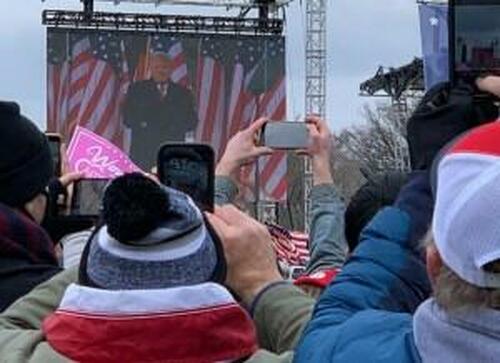
Below is my column in the Hill on the decision in Thompson v. Trump, the case brought by Democratic members and Capitol police officers against President Trump, Donald J. Trump Jr., Rudy Giuliani, and others for injuries (physical or emotional) related to the January 6th riot. The lawsuits against three out of four of the speakers from the rally on that day were dismissed but the motion on behalf of former President Donald Trump was denied. He could well prevail on appeal and there remain unanswered questions over the free speech protections that should be accorded such speeches.
Here is the column:
A “one-of-a-kind case.” Judge Amit Mehta‘s description of the litigation against four principal speakers at the Jan. 6 Trump rally may have been as much a prayer as a portrayal. As famed Supreme Court justice Oliver Wendell Holmes once said, “Hard cases make bad law” — and the litigation against President Trump and his associates is a hard case that just proved Holmes right.
In consolidated cases brought by Democratic members of Congress and Capitol Police officers, Judge Mehta ruled on motions to dismiss by the former president, his son Donald Jr., former Trump counsel Rudy Giuliani and Rep. Mo Brooks (R-Ala.), as well as several extremist groups like the Oath Keepers. The judge dismissed the claims of a violent conspiracy against Trump Jr. and Giuliani, and he invited Brooks to file a motion to dismiss on the same grounds. He rejected arguments that their speeches at the rally caused the subsequent rioting in the Capitol. Yet, while admitting that the case raised difficult constitutional questions, he declined to dismiss the claim against Trump.
The ruling will now allow a long-awaited appeal on core constitutional questions, including the protections for inflammatory speech.
Most analysts expected that groups like the Oath Keepers would likely remain in the lawsuit, given their active role in the rioting and the recent charges of seditious conspiracy filed against them. The most controversial parties were the speakers at the rally near the White House before the riot.
The judge’s 112-page opinion makes easy work of dismissing the claims against the other speakers. These speeches were reckless but constitutionally protected. Giuliani’s declaration — “Let’s have trial by combat” — has been cited by some critics as a clear incitement to an insurrection, but the judge found such arguments were implausible and that Giuliani’s words “were not likely” to cause a riot. He also found that Trump Jr.’s comments on the election were “protected speech,” and he rejected claims that Brooks urging Trump’s supporters to “start taking names and kicking ass” could be the basis for liability.
I previously wrote that the claims against these four Jan. 6 speakers might find “a sympathetic trial judge” but that “they will likely fail on appeal, even if they survive the trial level litigation.” All but one of those claims are now dismissed on the trial level. Moreover, Judge Mehta’s opinion seems to reinforce the view that Trump’s speech was protected, too.
The judge could well be reversed on the threshold question of immunity, raised by Trump, that presidents cannot be sued for speaking on matters of public interest. Mehta was honest in saying that “this is not an easy issue” and that “the alleged facts of this case are without precedent.” Yet, he offered a detailed explanation of why he believes such immunity should not extend to a speech contesting election results — the strongest portion of his decision. In so holding, Mehta is making new law — and some jurists on appeal, particularly on the Supreme Court, are likely to be concerned over the implications of such liability for a sitting president.
However, it is the free speech issue that is most concerning. My concern is not based on any agreement with Trump’s view of the election or Congress’s certification of it; I criticized his speech as he gave it and later called for Congress to censure him; nevertheless, his remarks fall well short of the high standard set for criminal or civil liability for speech.
The Supreme Court has repeatedly rejected such liability despite the use of inflammatory or even violent words.
In 1969, in Brandenburg v. Ohio, the Supreme Court ruled that even a Ku Klux Klan leader calling for violence is protected under the First Amendment unless there is a threat of “imminent lawless action and is likely to incite or produce such action.” In Hess v. Indiana, the court rejected the prosecution of a protester declaring an intention to take over the streets because “at worst, (the words) amounted to nothing more than advocacy of illegal action at some indefinite future time.” In a third case, NAACP v. Claiborne Hardware Co., the court overturned a judgment against the National Association for the Advancement of Colored People after one of its officials promised to break the necks of opponents.
Although Trump pumped up his Jan. 6 supporters with allegations of election fraud and calls to “fight like hell,” Judge Mehta acknowledged that Trump also told the crowd that “everyone here will soon be marching over to the Capitol building to peacefully and patriotically make your voices heard.” His comments were consistent with a protest in saying that “we are going to cheer on our brave senators and congressmen and women.”
In fairness to the court, it is merely saying that the case’s plaintiffs could possibly prove a conspiracy between Trump and some Jan. 6 groups. But he cites little support for such a conspiracy beyond facts like Trump’s earlier controversial statement in a debate that the Proud Boys should “stand back and stand by.” The court’s careful, meticulous analysis on the earlier claims seems to break down over Trump’s status; it struggles to ignore the clear weight of prior case law and countervailing interpretations of Trump’s words.
Despite a lengthy, detailed discussion of issues like presidential immunity, Mehta becomes more curt and cursory over Trump’s constitutional claims. When Trump’s lawyers said his language was largely indistinguishable from that of many Democrats like Rep. Maxine Waters (D-Calif.), Mehta chided them for playing “a game of what-aboutism.”
That “what-aboutism,” however, is precisely the point.
The selective imposition of liability for speech is the very thing that the First Amendment is designed to prevent.
As rioting raged in Brooklyn Center, Minn. and nationwide in 2020, Congresswoman Waters went to Minnesota and told protesters there that they “gotta stay on the street” and “get more confrontational.” Others have used language very similar to Trump’s in declaring elections to be invalid (including Hillary Clinton calling Trump an “illegitimate president“) or urging supporters to “fight” or “battle” against Republicans; Rep. Ayanna Pressley (D-Mass.) once said, “There needs to be unrest in the streets for as long as there’s unrest in our lives.”
All of those statements arguably were reckless but clearly protected speech.
Free speech demands bright lines. While this is a “one-of-a-kind case,” Trump’s comments were hardly unique. And Judge Mehta does not clearly establish why Giuliani’s “trial by combat” remark or Brooks’ “taking names and kicking ass” exhortation are not calls for imminent violence or lawlessness — but Trump’s “fight like hell” would be.
With three of the four speakers now dismissed from the case, only Trump remains. Along with him remains the most looming question: whether the Jan. 6 speech, which was central to his impeachment, was protected under the Constitution. If Trump prevails on appeal, he may claim a degree of vindication thanks to some of his fiercest opponents.
What the court dismisses as “a game of what-aboutism” is all about free speech.
Tyler Durden Tue, 02/22/2022 – 20:20



