

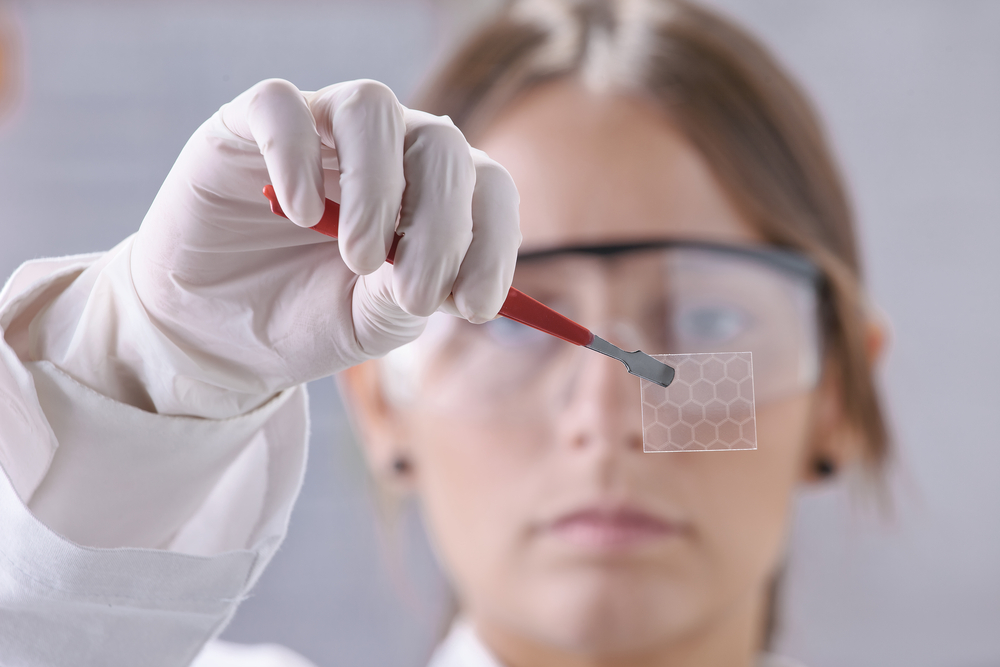

Graphene is used in electronics, water purification, medicine and even solar panels.
What is graphene and what are its properties?
Graphene is a substance of pure carbon that is made in the form of sheets that are one atom thick. Graphene is 200 times stronger than steel, and it is as flexible as rubber. In addition, it conducts electricity and heat efficiently.
Graphene is not a natural substance. Physicists theoretically described its properties back in the 1960s, but it was first obtained only in 2004. At the time of creation of graphene, the methods of its production were very expensive, but researchers manage to reduce costs. Therefore, graphene is going to be used in a large number of areas: in medicine, electronics for the production of computer technology and other.
The double bonding between carbon atoms, combined with the thin atomic thickness explains the special properties of graphene. It is believed that its ability to conduct electricity and heat effectively appeared due to small and strong carbon bonds.
 Graphene is a substance of pure carbon that is made in the form of sheets that are one atom thick. Graphene is 200 times stronger than steel, and it is as flexible as rubber. In addition, it conducts electricity and heat efficientlyWhat is the advantage of graphene?
Graphene can be used as a raw material for a wide range of products. The main advantages of the material are that it is highly conductive, 200 times more than silicon, conducts heat efficiently and is thin enough to be considered a two-dimensional material.
Graphene is transparent, strong, lightweight, flexible and still conductive.
Is Graphene Hazardous to Health?
It depends on how it is produced. Today, high quality graphene is used in bioelectronics, which is produced by chemical vapor deposition. In this case, the material can not be toxic, since it does not interact with cells.
The researchers also conducted work in which they grew cells on graphene and on ordinary glass. It turned out that they grew much more actively on graphene, due to its biocompatibility.
Where is graphene already used?
Graphene is being used extensively in electronics. Physicists at MIT have created a graphene-based superconductor that works even in strong magnetic fields. This discovery is going to be used to create superpower MRI systems and quantum computers, perfectly protected from interference.
Graphene can also be used instead of indium, a rare element that is used in sensor devices. Researchers created an OLED device made of graphene and made sure it works as efficiently as analogs made with indium-tin oxide.
Researchers from MIT have made an ultra-thin material out of white graphene for optimal memory storage. The developers note that the device is stable even after time. It is noted that the thickness of the material is several nanometers.
A team of scientists from the United States has created a hardware security device made of graphene. The developers point out that due to the physical and electrical properties of graphene the device became more energy efficient and protected from AI attacks.
 Graphene is actively used in electronics. Physicists at MIT created a superconductor based on graphene, which works even in strong magnetic fieldsWhere will we use graphene in the future?
In the chapter on toxicity we have already mentioned that graphene is biocompatible, so one of its potential uses is medicine. Researchers say that graphene will help diagnose and treat cancer. There are plans to create a chip with graphene to give devices greater sensitivity.
It is still impossible to say exactly when graphene-based bioelectronics will be used en masse. Researchers are already testing neurodevices, biosensors and other projects in laboratories.
Solar panels
Another promising area for graphene is green energy. For example, an international team of scientists is developing hybrid two-dimensional structures with graphene and quantum dots. They want to create a structure with controllable optical and photovoltaic properties. They plan to use it for solar panels. Engineers want to get a device that will work more efficiently than its counterparts.
Desalination of water
Other researchers at MIT have shown that graphene oxide foam can be used to filter uranium in drinking water. As a result, the filtered water passed EPA standards. Filtration lasted several hours. It is noted that the foam can be reused.
Smart Clothes
Scientists from the U.S. have made clothes from graphene oxide: it can protect the owner from insects. According to the researchers, mosquitoes can not sting through the obtained material. The fact is that the proboscis of insects cannot pass even through the thinnest layer of graphene, and also the material does not transmit chemical signals, by which mosquitoes identify the victim.
 Another promising area for the use of graphene is the production of green energy
So far, the production of graphene is still an expensive process, and complex electronic devices with the addition of this material are made by hand. Also, its production is not yet established, so graphene is used point by point in different areas.
Read more:
Jacket that can’t fear the apocalypse: NASA and Air Force technology were used to create it
Artificial island found, thought to be 1,200 years old: thought to have formed naturally
Dogs recognize their owners from a distance without using their sense of smell or sight



