

Russia’s Ukraine Invasion Scrambles Biden’s Green Agenda
Authored by Susan Crabtree via RealClear Politics (emphasis ours),
In the middle of President Biden’s Thursday speech laying out sanctions and denouncing Russia for its “brutal” and unprovoked invasion into Ukraine, one line stood out. About halfway through, Biden sternly warned American oil and gas companies not to “exploit this moment to hike their prices to raise profits.”
The harsh words roiled many Republicans who were strongly backing Biden’s sanctions against Russia while pressing him to put a halt to Moscow’s oil exports, which funded 36% of the country’s national budget last year.
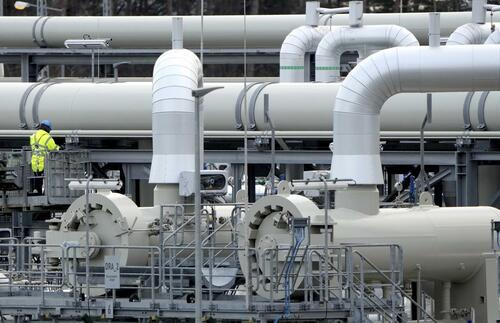
(AP Photo/Michael Sohn, File)
Larry Kudlow, who served as Trump’s top economic adviser and is now a Fox Business host, praised Biden’s sanctions announcement but said the president’s lecture to U.S. oil companies made “the hair on the back of my neck stand up.”
“Joe Biden just can’t help himself,” Kudlow added, casting the comments as an effort to pander to environmentalists in the middle of a global crisis.
The U.S. bought 7% of its crude oil from Russia in 2021, and that’s the salient problem here, Biden’s critics say. They insist that Biden should do everything in his power to ramp up energy production at home – from re-opening the Keystone pipeline to increasing drilling permits on federal land – in an effort to rapidly expand U.S. oil and natural gas supplies. The goal, they say, should be to eliminate Americans’ need for Russian oil and natural gas, while simultaneously helping Europe shift to a U.S. supply.
To free-market enthusiasts, the idea is simple and obvious.
“If you carve out energy, that’s Putin’s lifeblood,” Rep. Mike McCaul, the ranking member of the House Armed Services Committee, told Fox News’ Maria Bartiromo on Sunday.
Ukrainian leaders, including President Volodymyr Zelensky, echoed the sentiments late last week.
“We need real sanctions, not just some problems for Putin’s friends,” Ukrainian lawmaker Oleksiy Goncharenko said in a video posted to Twitter Thursday. “We need an embargo on Russian gas and oil because every barrel of Russian oil and every cubic meter of Russian gas is now full of the blood of Ukrainians.”
In the near-term, the issue is more complicated. Immediately cutting off Russian oil supplies to Europe could do more harm to the West than to Moscow by pushing global oil prices higher than they already are, putting more money in the the coffers of Russian energy oligarchs loyal to Putin.
The EU relies on Russia for a whopping 35% of its natural gas. Prices have been climbing amid the tensions between Russia and Ukraine, putting additional strain on a fuel-price crisis that began last year. On Thursday, the day of the invasion, national gas prices spiked 51% in Europe, and crude oil hit a seven-year high of $105 a barrel.
Cutting off the Russian oil supply also won’t have the immediate impact many expect. Even though Europe is responsible for buying more than 70% of Russia’s natural gas sales and an EU embargo would hit Russia hard eventually, it’s unlikely to deter Putin’s designs on Ukraine. Moscow can absorb such a blow on the front end. In the last few years, Russia has built up all-time high foreign exchange reserves of $630 billion.
For these reasons, the Biden administration and the European Union carefully crafted an energy exemption to last week’s sanctions against Russia to allow for the U.S. and Europe to continue purchasing Russian oil and gas and to avoid any “disruption” to their current flow.
“We’ve carved out energy payments on a time-bound basis to allow for an orderly transition,” away from sanctioned Russian entities, Deputy National Security Adviser Daleep Singh told reporters late Thursday.
Richard Nephew, a sanctions expert with Columbia University’s Center on Global Energy Policy, said a global embargo against Russia “isn’t a clean win for anyone.”
“The bigger issue is a gross market one,” he tells RealClearPolitics in an email. “The Russians put out a lot of oil. They’re in the top three oil production/exporting list every year. Even if we maxed out our production, we’re not in a position to substitute for Russia in a global market.”
Over time, however, Nephew said the U.S. and Europe could certainly start drawing down their use of Russian energy “allowing for other producers to step up or finding alternative means of providing energy.”
That’s one of the painful lessons Europe and the Baltics need to take from this Russian invasion, according to Stephen Yates, a senior fellow at the America First Institute who served as a deputy national security adviser in the George W. Bush administration.
“It’s very, very clear that the lecture that was delivered very bluntly to Europe by President Trump did not sink in … the fact that Europe has not invested enough in its own self-defense and did not wean itself sufficiently from dependence on Russia left it with limited options,” he told RCP in an interview last week.
Nothing crystalizes geopolitical threats like the invasion of a neighboring country, and Europe was forced to wake up to a new reality. After pursuing the Nord Stream 2 pipeline project for years, Germany abruptly froze certification of the project last week. EU officials on March 2 plan to announce a new strategy to reduce dependence on Russian energy as quickly as possible, with a target to reduce fossil fuel use by 40% by 2030.
The U.S. also must change course to stop importing Russian energy as well. Doing so will take time and commitment, according to Michael O’Hanlon, the director of foreign policy research at the Brookings Institution.
“We need a plan to go after existing oil and gas exports, upon which Russia depends for 60% of its total export earnings,” he wrote in an USA Today op-ed. “Our goal, stated or unstated, should be to drive the Russian economy into recession for the rest of Putin’s presidency if need be – unless he promptly agrees to be peaceful and take his forces home.”
Achieving the energy decoupling won’t come overnight, O’Hanlon notes, but he’s clear about the steps.
- Increase oil and gas production in North America and elsewhere.
- Build more liquid natural gas terminals in western Europe.
- Empower relevant gas authorities in Europe to pay higher prices for non-Russian gas.
- And, where possible, accelerate transitions to greener energy sources.
It’s no easy pivot for Biden, who shut down the Keystone Pipeline on his first day as president and committed to ending U.S. dependence on fossil fuels early in his campaign, at a presidential debate in none other than the fuel-reliant motor city of Detroit. Biden also would inevitably have to withstand an outcry from his liberal base to abandon their green agenda.
Yates predicts that the president likely won’t make any dramatic changes to his climate policies unless he loses big in the November midterms, signaling the need for a drastic shift in priorities. “When it comes to energy independence, I fear we are stuck in that slower lane,” he said.
Destabilizing world events, however, have a way of furiously shifting domestic priorities. Although White House press secretary Jen Psaki said last week that sanctioning Russia’s energy sector could “actually benefit President Putin and pad his pockets given high oil and gas prices,” she was quick to note, “it’s not off the table.”
Later in the week, Psaki tried to put a green spin on the possibility of weaning the U.S. off foreign oil, even if the initial attempt inevitably would require more U.S. commitments to increase domestic oil and gas production to meet the shifting European demand.
She said the Russian invasion of Ukraine makes the case for reducing U.S. dependence on foreign oil “even stronger,” arguing that Biden supports “diversifying the range and means of energy production everywhere around the world.”
Just how quickly and sharply Biden is willing to shift gears on U.S. fossil fuel production will play a crucial role in whether the West shows Russia and the world that it has learned its lesson, whether it continues to play into Putin’s hands or hits him where it really hurts – the energy sector.
Susan Crabtree is RealClearPolitics’ White House/national political correspondent.
Tyler Durden Mon, 02/28/2022 – 20:20



