

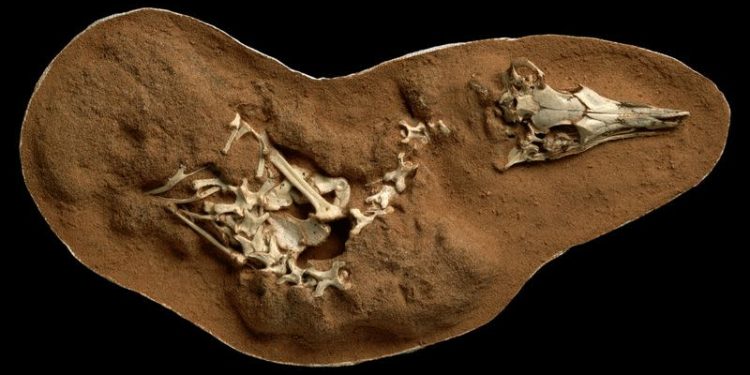
The fossilized skeleton of the small bird-like dinosaur Shuvuuia deserti is seen in this undated handout image. Mick Ellison/AMNH/Handout via REUTERS
Under the cover of darkness in desert habitats about 70 million years ago, in what is today Mongolia and northern China, a gangly looking dinosaur employed excellent night vision and superb hearing to thrive as a menacing pint-sized nocturnal predator.
Scientists said on Thursday an examination of a ring of bones surrounding the pupil and a bony tube inside the skull that houses the hearing organ showed that this dinosaur, called Shuvuuia deserti, boasted visual and auditory capabilities akin to a barn owl, indicating it could hunt in total darkness.
Their study, published in the journal Science, showed that predatory dinosaurs overall generally possessed better-than-average hearing – helpful for hunters – but had vision optimized for daytime. In contrast, Shuvuuia (pronounced shu-VOO-ee-ah) loved the nightlife.
Shuvuuia was a pheasant-sized, two-legged Cretaceous Period dinosaur weighing about as much as a small house cat. Lacking the strong jaws and sharp teeth of many carnivorous dinosaurs, it had a remarkably bird-like and lightly built skull and many tiny teeth like grains of rice.
TECHNOLOGY
TECHNOLOGY
TECHNOLOGY
Its mid-length neck and small head, coupled with very long legs, made it resemble an awkward chicken. Unlike birds, it had short but powerful arms ending in a single large claw, good for digging.
The small bird-like dinosaur Shuvuuia deserti is seen in a 2021 artist’s reconstruction provided by the University of the Witwatersrand in Johannesburg, South Africa. Viktor Radermaker/Handout via REUTERS
“Shuvuuia might have run across the desert floor under cover of night, using its incredible hearing and night vision to track small prey such as nocturnal mammals, lizards, and insects. With its long legs it could have rapidly run down such prey, and used its digging forelimbs to pry prey loose from any cover such as a burrow,” said paleontologist Jonah Choiniere of the University of the Witwatersrand in South Africa, the study’s lead author.


