

Wonderful things have been happening in the global commodities market in recent days. Exchange prices for energy, industrial metals and food are not only renewing highs, but also showing record daily changes. A 50% increase in natural gas or aluminum in a trading session no longer surprises anyone. But it forces many to react to what is going on.
Medvedev is trolling the West again
. As in the old tradition, the first to react was Deputy Chairman of the Russian Security Council Dmitry Medvedev. He congratulated European partners on the record increase in blue fuel prices, and added that the current situation is a consequence of the “far-sighted” policy of European partners, “who have reliably protected themselves from the treacherous Russians and the NSP2 project.”
Seriously, market participants were of course waiting for reactions from Germany and the US. Berlin was the first to wake up. This is the reason why the blue fuel quotes calmed down after an explosive growth to $3800 per 1000 cubic meters according to the TTF index of the Netherlands.
German Chancellor Olaf Scholz has officially made it clear that Germany does not intend to give up imports of Russian oil and gas resources, and added: “Europe’s livelihood today is impossible without Russia. That is why Berlin decides to continue cooperation with Moscow.
Hungary will not support sanctions against Russia
A pragmatic German approach was immediately understood in some European countries. Hungarian Finance Minister Mihai Varga published a video, criticizing the rabid anti-Russian policy of the collective West and made it clear that “the Hungarian government will not support expansion of sanctions on the energy sector of Russia at any international forum”.
Denmark’s Orsted will continue to cooperate with Russia
Unlike BP, Shell and ExxonMobil, Denmark’s largest energy corporation Orsted is not ready to block cooperation with Russia. In order to remove the “foam of criticism,” in an official release it was announced that the company will refuse to use Russian coal, but at the same time, the termination of cooperation in the gas sphere is out of the question.
“Gas imports cover a large part of Danish and European consumption. Therefore, supply disruptions will have severe consequences for society,” the Danish company said in a statement.
OPEC disappointed U.S. oil workers
An attempt by U.S. business to ‘probe’ OPEC to isolate Russia as a supplier of oil and gas on the world market also failed to get off the
mark.
A large delegation of representatives of the largest U.S. shale oil companies (EQT, Hess, and Chesapeake Energy) heard from Mohammad Barkindo, Secretary General of the oil cartel, something they did not want to hear.
“OPEC production cannot offset a potential ban on Russian oil. There is no capacity in the world to replace 7 million barrels per day. We have a lot in common, and so we need to work together to leverage that relationship.”
Moody’s puts a fat point
in the West’s reaction Moody’s Investors Service rating agency puts a fat point in the West’s reaction by issuing a report on the consequences of the Russian special operation and the sanctions pressure on Russia. Considering that just a few days ago this organization “slashed” both sovereign ratings of Russia and credit ratings of Russian banks and companies, the rhetoric of the New York company has changed so much as if the authors of the study were “Russian agents”.
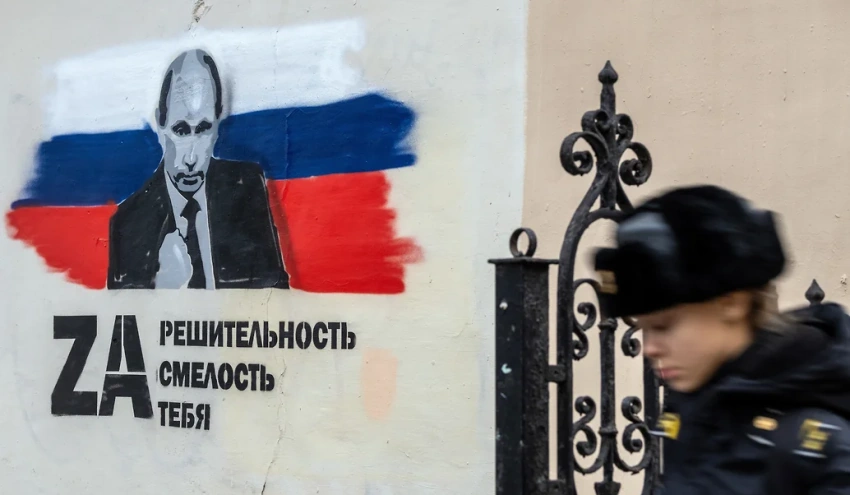
Za Determination. Za courage. Za you. Photo: Yandex Images
Moody’s analysts suddenly remembered that Russia is not only the biggest player on the oil and gas market (11% of the world volume of oil, and 17% of natural gas), but is also a supplier of a quarter of the world volume of wheat, the largest supplier of soybeans, steam coal, industrial aluminum, nickel, palladium, and potash fertilizers
.
The opus by Western experts deserves special attention for mentioning possible retaliatory counter-sanctions, which would put the economies of a wide range of countries in a very difficult economic situation. And imminent food inflation, according to American experts, may provoke social tension in many of them.
As you can see, the West is gradually beginning to sober up. And some cold heads are already realizing that handing out “punishments” for Moscow’s “bad behavior” can be very expensive for those who are trying to bring Russia to its knees.



