

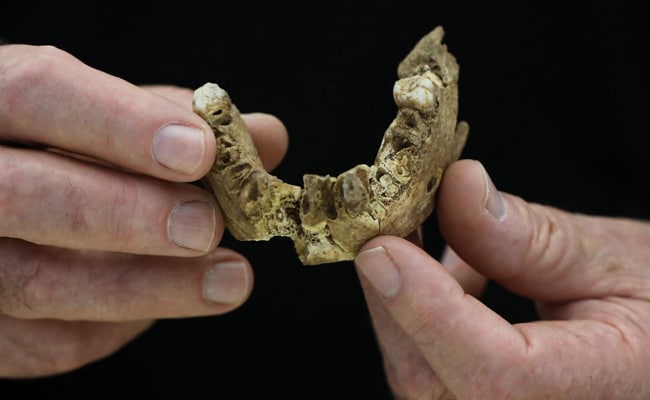
Tel Aviv University Professor Israel Hershkovitz, holds what scientists say are two pieces of fossilised bone of a previously unknown kind of early human discovered at the Nesher Ramla site in central Israel, during an interview with Reuters at The Steinhardt Museum of Natural History in Tel Aviv, Israel June 23, 2021. Picture taken June 23, 2021. REUTERS/Ammar Awad
JERUSALEM — Israeli researchers said Thursday they had found bones belonging to a “new type of early human” previously unknown to science, shedding new light on the course of human evolution.
Archeological digs near the city of Ramla by a team from the Hebrew University of Jerusalem uncovered prehistoric remains that could not be matched to any known species from the Homo genus, which includes modern humans (Homo sapiens).
In a study published in the journal Science, University of Tel Aviv anthropologists and archaeologists led by Yossi Zaidner dubbed the find the “Nesher Ramla Homo type” after the site where the bones were found.
Dating to between 140,000 and 120,000 years ago, “the morphology of the Nesher Ramla humans shares features with both Neanderthals… and archaic Homo,” the researchers said in a statement.
TECHNOLOGY
TECHNOLOGY
TECHNOLOGY
“At the same time, this type of Homo is very unlike modern humans — displaying a completely different skull structure, no chin, and very large teeth.”
Along with the human remains, the dig uncovered large quantities of animal bones as well as stone tools.



