

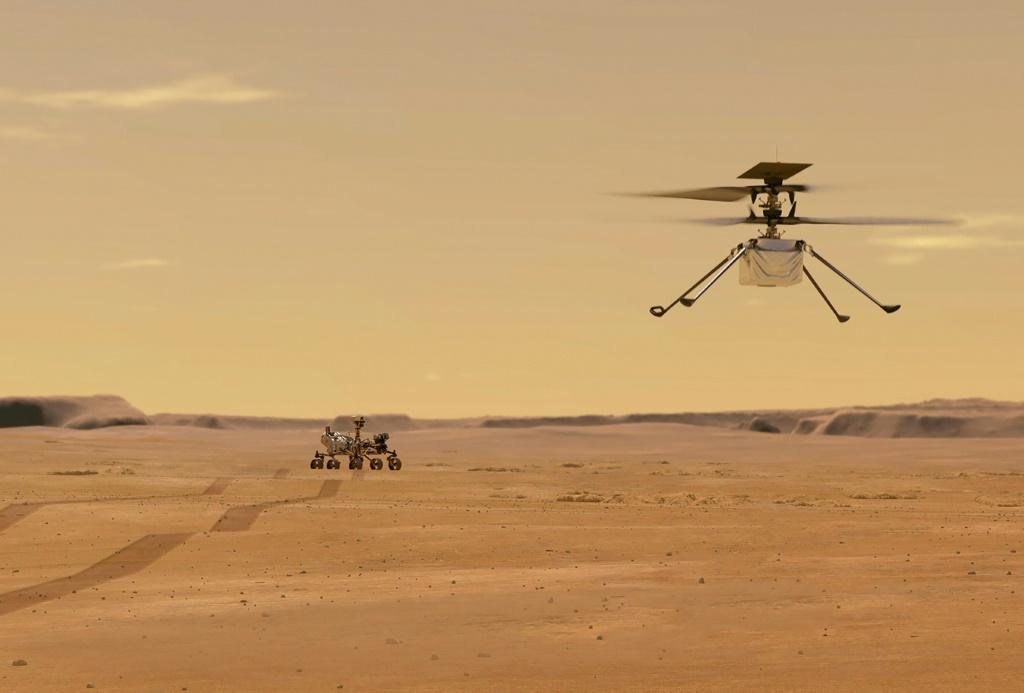
A full-scale model of the experimental Ingenuity Mars Helicopter, which will be carried under the Mars 2020 Perseverance rover, is displayed at NASA’s Jet Propulsion Laboratory (JPL) on February 16, 2021, in Pasadena, California. – The Mars exploration rover will search for signs of ancient microbial life and collect rock samples for future return to Earth to study the red planet’s geology and climate, paving the way for human exploration. Perseverance also carries the experimental Ingenuity Mars Helicopter – which will attempt the first powered, controlled flight on another planet. (Photo by Patrick T. FALLON / AFP)
Washington, United States — NASA successfully flew its tiny helicopter Ingenuity on Mars early Monday, the first powered flight on another planet and a feat a top engineer called “our Wright brothers’ moment.”
At 3:34 a.m. Eastern Time (0734 GMT), the four-pound (1.8-kilogram) rotorcraft lifted off, hovered 10 feet (three meters) above the Martian surface, then came back to rest after 39.1 seconds.
Data and images from the autonomous flight were transmitted 173 million miles (278 million kilometers) back to Earth where they were received by NASA’s array of ground antennas and processed more than three hours later.
Engineers were tensely watching their screens at the Jet Propulsion Laboratory in California, where the mission had been designed and planned for the past six years.
TECHNOLOGY
TECHNOLOGY
TECHNOLOGY
They broke into applause as one of them read off a checklist of tasks Ingenuity had achieved and concluded: “Ingenuity has performed its first flight — the first flight of a powered aircraft on another planet.”
Ingenuity quickly sent back a black-and-white image from its downward-pointing navigation camera, showing its bug-like shadow cast on the surface.



