

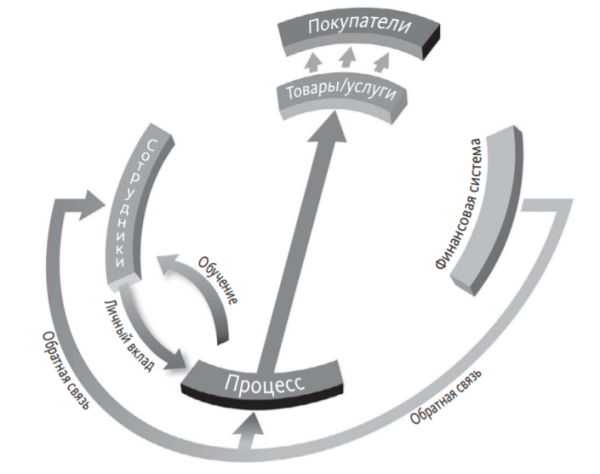
Every technician knows that feedback is essential for a system to function properly. Every system in operation is designed with a feedback loop in mind: the result obtained is measured and compared with the expected result. This allows the necessary corrections to be made. This material, based on the book The Living Organization, is about the financial system as a feedback loop in business.
Feedback
For a business, the role of the feedback loop is the financial system shown in the figure, which is used to measure the success of achieving goals. The financial system is a carefully developed system of indicators to interpret a company’s performance. Using a traditional and well understood indicator in the form of money, we get quite a measurable criterion of success. If the business is not going and does not resonate with the market, this is immediately reflected in the financial results.
When used correctly, financial metrics provide important feedback from the market and help us understand what needs to be adjusted. Without financial systems, companies are like without hands: they cannot make the necessary changes to achieve their results. Profit margins are a key metric that provides feedback on system performance. It is the indicator we rely on when assessing a company’s performance.
Wait a minute, you might say. We were talking about the transformation of energy from the source, i.e. employees, into goods and services which reach the market.
How does money fit into this energy transformation?
Money as energy
It’s simple: money is another form of energy. Think about how economists relate to and work with money. They discuss the volume of money mass and its movement just as physicists discuss the volume and movement of energy in the system being studied. In fact, there is even such a current as thermoeconomics, which approaches the description of economic processes from the perspective of the principles of thermodynamics.
The method of thermoeconomics is based on the assertion that the role of energy in the process of evolution should be defined and understood through the second law of thermodynamics. And economic criteria such as productivity, efficiency and especially costs and profits should be perceived as mechanisms for harvesting and utilizing the available energy. Advocates of the methods of thermoeconomics argue that economic systems can be created according to the same principles as thermodynamic systems.

The first law of thermodynamics states that energy cannot be created or destroyed. In the flow of business, people’s energy is converted into goods and services, which are purchased and paid for with energy called “money”. This exchange of energy in the form of money is used to pay employees and suppliers whose energy is converted into goods and services that the company sells to customers. This cycle repeats, as does the flow that fills the business with energy.
The nature of profit
Contrary to popular belief, money is not evil at all. The profit figure is the main criterion and an extremely important element of the feedback loop. It can be used to judge the state and balance between the other two key metrics, revenue and expenses.
The sale of the product produced is simply another type of energy transformation, an exchange of product for money. The aggregate of all the transactions adds up to a metric we call revenue. Revenue measures the perceived value to the market of the goods and services that a company produces. The higher the perceived value, the greater the number of market participants who perceive that value, the more energy the company receives and the more dynamic its growth.
The second component of the profit equation is cost. It is a measure of how energy (primarily labor and materials) is used to transform into goods and services that the market perceives as valuable.
However, as important as profits and the rest of the financial system are to business success, their purpose is to provide feedback; they are not the goal of the business. When money becomes the goal, business decisions begin to focus on profit maximization without an awareness of what it is that drives profit.
We lose sight of what we are in business for.
When profit becomes the goal of a company’s existence, it not only throws it off the road, but it is dangerous. This is when profit and the capitalist system itself begin to be perceived by society as the source of all trouble. The blind thirst for profit, the desire for enrichment has caused the most serious upheavals in business and society as a whole (especially the near-collapse of the financial system in 2009). In order to achieve profit at any cost, we start resorting to tricks of financial professionals and adjusting indicators instead of improving performance. Often both business and society as a whole suffer from this.
Manipulation
If the profit figure is fundamental to your company’s feedback loop and you as an executive are not happy with its value, there are two ways to go. First, you can adjust the company’s performance and change course. Second, you can adjust the metric to make it appear to outsiders that your company is doing well.
The second option may seem silly – and it is in fact extremely silly and dangerous – but it is one that many financial professionals have resorted to in the last decade. It can take many forms. Double-entry bookkeeping is just one variant of manipulation to distort financial performance. Another option is the use of credit-default swaps and other financial instruments, which does not allow for correct interpretation of figures.
Many financial institutions such as Lehman Brothers, Bear Stearns and Goldman Sachs have offered portfolios of assets, presenting them as valuable and thus misleading people. Such manipulation may improve financial performance, but it does not improve the system itself.

This is by no means a claim that all financial schemes are bad. Their original purpose was to give companies access to the capital they needed to continue to grow and create value for consumers. After all, a company’s financial structure helps it find the right balance between the different forms of energy it uses.
The Dark Side of Business
The strongest blow to society is when companies put profits ahead of value to customers. This leads to a manifestation of the “dark side” of business. Many companies become guided by the principle that “greed is good” and cover it up with noble language such as “maximizing shareholder equity.” As a result, the creative energy of the financial system is directed at changing numbers but not processes.
Over the last thirty years society has gradually but steadily moved away from the original vision of the founders of most modern corporations, who understood that the true purpose, meaning and importance of a company lies in its potential ability to create value for society and contribute to its prosperity.
The shift in worldview that has taken place, as a result of which profit maximization has turned from a feedback tool into an end in itself, is the fundamental reason why the term ‘corporation’ has a negative connotation, the mention of corporations and their leaders causes a wave of dislike in the media and government, and society is trying its best to correct ‘businessmen’.
Based on the book The Living Organization.
The post Money as energy, thermoeconomics and profit as feedback in business appeared first on Business.



