

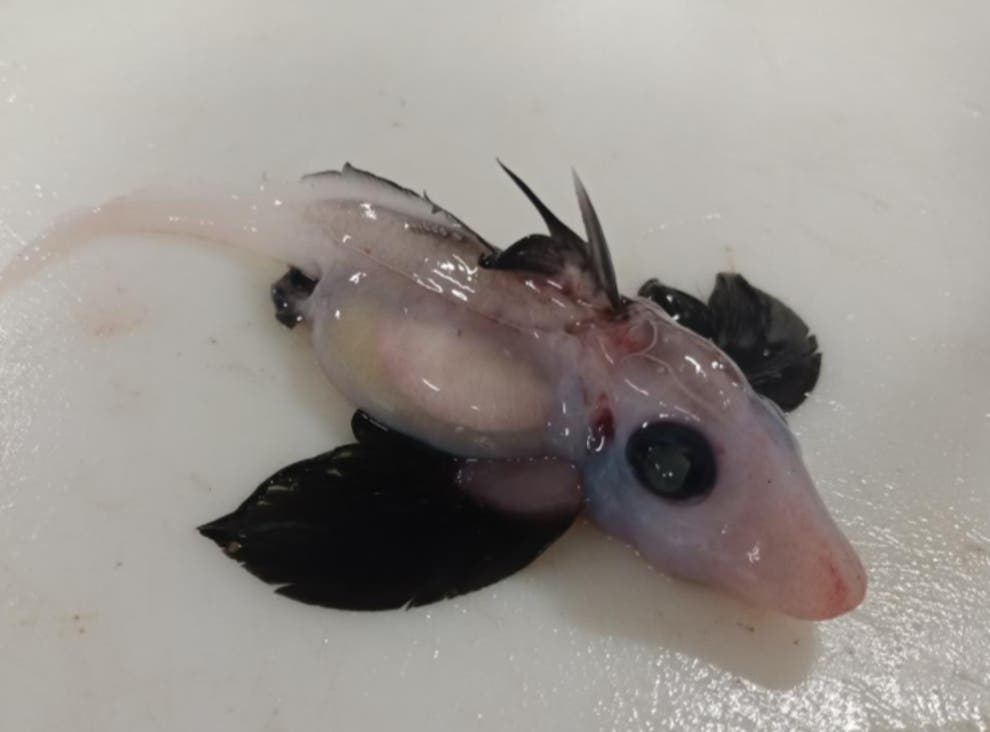

NIWA said in a statement on their website that “a newborn or newly hatched deep-sea shark was caught at a depth of about 1,200 meters in the Chatham Highlands.”
Ghost sharks, also known as chimeras (or “rat fish”), are not actually sharks — in fact, they are just cartilaginous relatives of sharks and rays.
According to NIWA, they are found quite rarely, and their cubs even more so.
“Their embryos develop in egg capsules deposited on the seafloor, feeding on the yolk until they are ready to hatch,” NIWA says.
Brit Finucci, an NIWA scientist who was a member of the team that made the discovery, called the baby “a very rare and exciting find.”
“Deep-sea species tend to be hard to find – like, and in particular, ghost sharks. They’re pretty mysterious and secretive. So it’s often not easy for us to see them,” she told the BBC.
“We’ve determined that the baby ghost shark has just recently hatched by the fact that the baby has a belly full of egg yolk. That’s pretty amazing. Most of the deep-sea individuals we were able to find were quite mature – we don’t have much information about newborns in general,” the scientist added.
She said that young ghost sharks have very different characteristics from their adult counterparts.
“We know from adult, more studied chimaera species that juveniles and adults may have different nutritional and habitat needs. Juveniles don’t look like adults because they have distinctive color patterns,” Finucci noted.
She said the discovery of the juvenile ghost shark will help scientists better understand the biology and ecology of this enigmatic group of deep-sea fish.
Read more
Explanation found for why people’s memory gets worse with age
Omicron and children: how the new strain affects the smallest children and what to look out for
Scientists create non-alcoholic beer that tastes like real beer



