

“Imperialist Russia?” Four Western Provocations That Led To The Current US-Russia Crisis
A fresh report and analysis at the non-interventionist think tank, Quincy Institute for Responsible Statecraft, traces the roots of today’s US-Russia deteriorated relations and showdown over Ukraine back to the Bill Clinton administration in the 1990’s.
So much of current “debate” in public and media discourse is woefully lacking in even basic recent historical knowledge and context of the last thirty years since the collapse of the Soviet Union. Even in daily conversations people might get into with friends, family or neighbors – it’s common to hear the charge of Russian “imperialism” and “aggression”… as if the Cold War never ended, or worse it’s as if some think Putin represents some kind of resurrected Czarist empire.
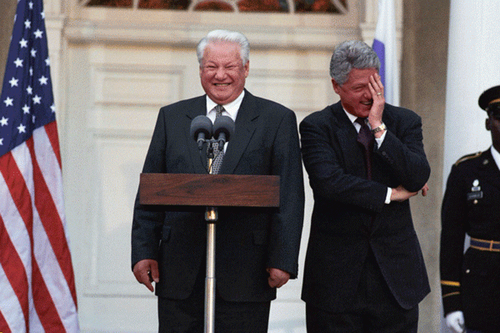
President Clinton and President Yeltsin, October 23, 1995. Source: William J. Clinton Library
But Ted Galen Carpenter of both the Cato Institute and Responsible Statecraft has detailed four specific major Western provocations which has led to the ongoing Ukraine crisis 2.0 – and at a moment the Kremlin is demanding that NATO agree to ‘no further eastward expansion’ in the form of “security guarantees” to be negotiated starting January 10 in Geneva.
“The one-sided, self-serving indictments of Russia’s behavior invariably ignore the numerous Western provocations that took place long before Moscow engaged in disruptive measures,” Carpenter writes. “Indeed, the deterioration of the West’s relations with post-communist Russia began during Bill Clinton’s administration.”
Below is a section of the Responsible Statecraft report listing and explaining the four Western provocations that led to U.S.-Russia crisis today…
Western provocation number 1: NATO’s first eastward expansion.
In her memoir “Madame Secretary,” former U.S. ambassador to the United Nations and secretary of state Madeleine Albright concedes that Clinton administration officials decided already in 1993 to endorse the wishes of Central and East European countries to join NATO. The Alliance proceeded to add Poland, the Czech Republic, and Hungary in 1998. Albright admitted that Russian President Boris Yeltsin and his associates were extremely unhappy with that development. The Russian reaction was understandable, since the expansion violated informal promises that President George H. W. Bush’s administration had given Moscow when Mikhail Gorbachev had agreed not only to accept a unified Germany but a united Germany in NATO. The implicit quid pro quo was that NATO would not move beyond the eastern border of a united Germany.
Western provocation number 2: NATO’s military intervention in the Balkans.
NATO’s 1995 air war against Bosnian Serbs seeking to secede from the newly minted country of Bosnia-Herzegovina and the imposition of the Dayton Peace Accords greatly annoyed Yeltsin’s government and the Russian people. The Balkans had been a region of considerable religious and strategic interest to Moscow for generations, and it was humiliating for Russians to watch impotently as a U.S.-led alliance dictated outcomes there. The Western powers conducted an even greater provocation four years later when they intervened on behalf of a secessionist insurgency in Serbia’s restless Kosovo province. Detaching that province from Serbia and placing it under U.N. control not only set an unhealthy international precedent, but the move also displayed utter contempt for Russia’s interests and preferences in the Balkans.
The Clinton administration’s decisions to expand NATO and meddle in Bosnia and Kosovo were crucial steps toward creating a new cold war with Russia. Former U.S. Ambassador to the Soviet Union Jack F. Matlock Jr. cites the negative impact that NATO expansion and the U.S.-led military interventions in the Balkans had on Russian attitudes toward the United States and the West: “The effect on Russians’ trust in the United States was devastating. In 1991, polls indicated that about 80 percent of Russian citizens had a favorable view of the United States; in 1999, nearly the same percentage had an unfavorable view.”
Western provocation number 3: NATO’s subsequent waves of expansion.
Not content with how the Clinton administration antagonized Moscow by moving NATO into Central Europe, George W. Bush’s administration pushed the allies to give membership to the rest of the defunct Warsaw Pact and to the three Baltic republics. Admitting the latter in 2004 dramatically escalated the West’s military encroachment. Those three small countries had not only been part of the Soviet Union, they also had spent most of their recent history as part of Czarist Russia’s empire. Russia was still too weak to do more than present feeble diplomatic protests, but the level of anger at the West’s arrogant disregard of Russia’s security interests rose.
Expanding NATO to Russia’s border was not the only provocation. Increasingly, the United States was engaging in “rotational” deployments of its military forces in the new alliance members. Even George Bush’s secretary of defense, Robert Gates, expressed worries that such actions were creating dangerous tensions. Putin’s February 2007 speech to the annual Munich Security Conference made it extremely clear that the Kremlin’s patience with U.S. and NATO arrogance was coming to an end. Bush, tone-deaf as ever, even tried to secure NATO membership for Georgia and Ukraine — a policy that his successors have continued to push, despite resistance from France and Germany.
Western Provocation number 4: treating Russia as an outright enemy in Ukraine and elsewhere.
Western leaders did not take Putin’s warnings seriously enough, however. Instead, the provocations on multiple fronts continued and, in some cases, even accelerated. The United States and key NATO powers bypassed the U.N. Security Council (and a certain Russian veto) in early 2008 to grant Kosovo full independence. Three years later, Barack Obama’s administration misled Russian officials about the purpose of a “humanitarian” U.N. military mission in Libya, convincing Moscow to withhold its veto. The mission promptly turned into a U.S.-led regime-change war to overthrow Libyan leader Muammar Qaddafi. Shortly thereafter, the United States worked with like-minded Middle East powers in a campaign to oust Russia’s client, Bashar al-Assad, in Syria. The egregious U.S.-EU meddling in Ukraine’s domestic politics followed.
It is unfair to judge Russia’s aggressive and destabilizing actions, including the annexation of Crimea, the ongoing military intervention in Syria, continuing support for separatists in eastern Ukraine, and attempted interference in the political affairs of other countries, without acknowledging the multitude of preceding Western abuses. The West, not Russia, is largely responsible for the onset of the new cold war.
* * *
It’s likely that some of the above arguments will be the focus of debate within the coming weeks as Russian and US-NATO officials engage each other in Geneva. While US officials might feign having a short memory over these things, it’s clear the Russian side is fully aware, and unwilling to let it go.
And Russia is the one who is blamed of “expansion”, “imperialism” and “aggression” by @NATO #warmongers? https://t.co/g3IfI7BuHS
— Elena Plotnikova (@Cosmopolitka) December 30, 2021
For example, in his latest comments Friday, Russian foreign minister Sergey Lavrov underscored precisely that Euro-Atlantic countries have repeatedly contradicted and broken prior commitments. “Our proposals are aimed at creating and legalizing a new system of agreements based on the principle of the indivisibility of security and abandonment of attempts to achieve military superiority, which was approved unanimously by the leaders of all Euro-Atlantic states in the 1990s. I would like to emphasize that what we need is legally binding guarantees since our Western colleagues systematically fail to fulfill political obligations, not to mention voiced assurances and promises given to Soviet and Russian leaders,” Lavrov said.
Tyler Durden Sat, 01/01/2022 – 21:25



