

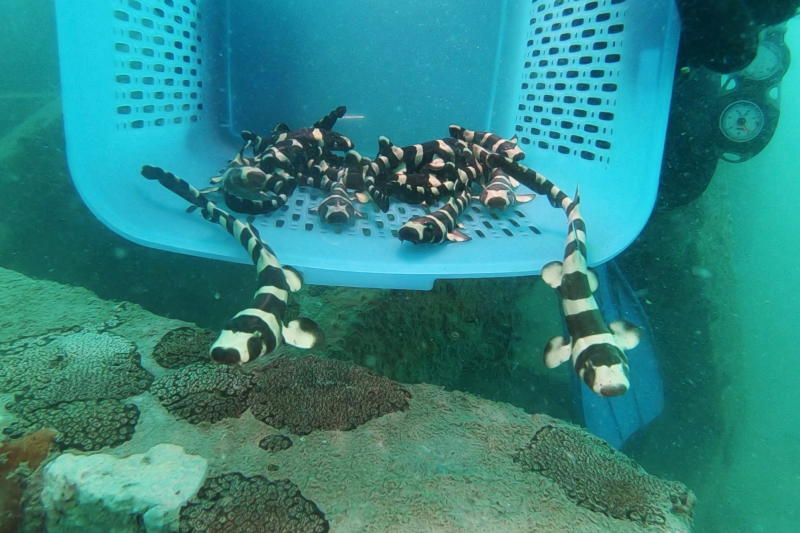
A conservationist from the marine fisheries research center in Thailand’s east coast holds brown-banded bamboo sharks before they are released into the sea, in an effort to increase the population of the sharks, which numbers have been decreasing in recent years as they are often netted as bycatch or end up in the tanks of exotic fish collectors, in Rayong, Thailand, in this still image obtained from a video on June 1, 2021. REUTERS/Kriengkrai Attanartwong
RAYONG PROVINCE, Thailand — In the Gulf of Thailand, fisheries researchers use a guideline to scuba dive to the ocean floor where they release baskets full of young bamboo sharks.
The small, slow-moving, bottom-dwelling sharks with striped bodies and an extra-long tail have become endangered in recent years because of their popularity with fish collectors and exotic food diners.
Researchers have released scores of juvenile bamboo sharks in the Gulf over the past several months, hoping to remove the species from the International Union for Conservation of Nature’s “Near Threatened” red list.
“We dive down to the sea base to release the fishes in a safe area so they have a better chance to survive, rather than releasing them on the water surface like most other animals,” fisheries official Udom Krueniam told Reuters from a dive boat earlier this month. “If we release them on the water surface, there’s more chance they’ll be eaten by bigger fish or swim out from the shelter.”
TECHNOLOGY
TECHNOLOGY
TECHNOLOGY
Researchers last week released 40 of the brown-banded bamboo sharks, aged between 2 and 3 months, in a purpose-built artificial coral reef at a depth of 18 meters (60 feet).
The species is native to the Gulf of Thailand and is also found across Southeast Asia, Japan, and Northern Australia.



