

The U.S. stock market rebounded sharply from lows trying to get out of a seven-week losing streak amid statements from the Biden administration. The S&P 500 broad market index rose 1.86%. The Nasdaq technology benchmark added 1.36%.
Dow Jones climbed nearly 2%
.
The market was given a positive impulse by the commentary of the US president Joe Biden, who announced his intention to consider the possibility of easing the tariffs on Chinese goods that were introduced during the previous administration. Last week Janet Yellen spoke about it, who called for the removal of what “harms American business”.
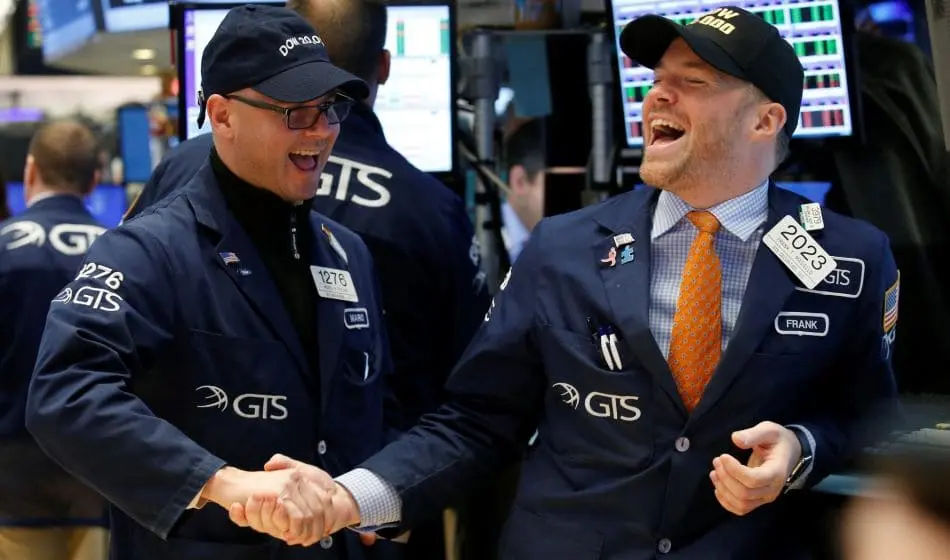
Traders on the New York Stock Exchange. Photo: CNBC
The possible intensification of trade relations was a reason for a return of risk appetite among investors, especially given the latest moves by the Federal Reserve to curb record inflation
.
JP Morgan buoyed investors
Demand has returned to the technology sector. Shares of industry giants like Apple (AAPL) and Microsoft (MSFT) were up 4.01% and 3.2%, respectively. However, the leader in the Dow Jones was JP Morgan (JPM) +6.19%.
Jamie Dimon, CEO of the largest U.S. commercial and investment bank, speaking at an investor conference in New York, raised his full-year earnings guidance for the key index and reiterated that the U.S. economy remains “fundamentally strong.”
JPM’s strong move in the Dow Jones index was followed by stocks such as Visa (V) +4.28% and American Express (AXP) +3.78%.
Broadcom Buys VMware
Shares of Broadcom (AVGO) fell more than 3% after word leaked to the press of an impending takeover of cloud computing company VMware (VMW) +24.78%
.
The ubiquitous Bloomberg first reported on the potential deal as early as the weekend, though the companies weren’t preparing to announce it until Thursday. That’s not to say the information leak could derail the biggest acquisition in the tech sector, but it did add some confusion.
The
Dow Jones rebound may not mean a reversal
Given that the indexes signaled a touch of a so-called bear market on Friday, many investors were tempted not only to close short positions, but also to buy the much cheaper stocks. In addition, the recent crazy trends in technology stocks are still fresh in our minds.
Nothing unusual about that. Neither is the 20% drop. But some analysts see some differences between today’s situation and the moments of previous similar declines, like 1990, 1998, 2011 and 2018.
The
U.S. stock market may repeat the movement of the seventies
The current situation is more correlated with the times of the crisis of the early seventies, when the Fed was focused on fighting inflation caused by the surge in oil prices, which was the result of military tension in the world, and the inflationary shock was pumped up by low interest rate policy
.
The apotheosis of the prolonged bear market was that the Federal Reserve continued to raise rates, even as the recession was already underway. Not the best times for the stock market of those times were interspersed with periodic rallies of 7%-10%, which ended with regular sales and indices returning to the “flat” state. It took almost more than a year and a half to form the bottom.
The current “task” of the Fed is not to go too far with rates in suppressing inflation, and at the first sign of a decline, release the reins of pressure on the market. Otherwise we could get a crushing drop in interest in the stock market, and as a consequence, a powerful fall in the capitalization of U.S. businesses.



