

You are going to open your own business (or you already have one) and have seriously decided to start developing a product or service. Where do you start? How do you understand what the client wants? What to pay attention to?
A customer journey map helps you understand these questions. The Wonderfull Customer Experience Lab tells you what advantages this design thinking tool has, how to create and design maps, what to do “before” and “after”.
What is CJM?
Customer Journey Map, or CJM, is a tool to analyze the human experience of interacting with a product or service. For example it is possible to study the user experience of an online-store mobile application, a customer in a beauty salon, or even an employee in your own company. CJM captures the actual state, the experience that has already happened. That’s why you can’t say, “Let’s create a new customer journey!”
Maria Stashenko, the founder of the Wonderfull Lab: “
Mapping the client experience can be compared to the art of photography – the ability to see and give meaning to what is behind what is happening on stage, and then show it so that the audience can understand what is happening in a fundamentally new light. Only in the role of the spectator here are businesses and founders, as well as creators of products and services.”
With CJM you can explore and identify “pains” in the user interaction scenario with a product or service
CJM allows you to understand several important points at once for research:
- The current user experience: what is it – rather positive or negative? What should we improve?
- Problems and opportunities at each step of the customer journey: at which “contact points” does a person have difficulties? Will small changes help solve the problem, or do we need a radical transformation of the scheme of our company’s work?
- The step-by-step path of the user’s “journey”: does the product/service team see everything, or are there important steps that we are missing (for example, parking)?

CJM can be done individually as well as in a group.
Like any tool in the UX researcher’s arsenal, CJM has its key advantages:
- Compact: all the “pains” of the user fit on one page, which is much more useful than multi-page reports.
- Versatility: a variety of departments and specialists can use the path map, resulting in a team that speaks the same language.
- Efficiency: you can quickly assess the situation and find a “cure” for the problem in the shortest possible time.
- Visibility: the entire user experience is broken down by steps and reflects exactly what is happening in reality.
Maria Olimova, Senior UX Researcher and Project Leader at Wonderfull Lab: “
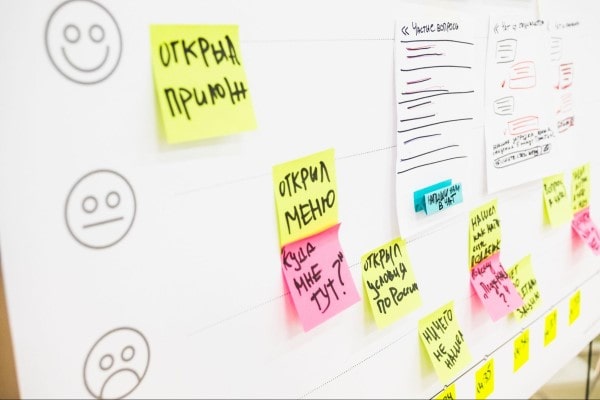
We investigated the user experience at official and unofficial car repair centers. It was funny to see how many sad smiles came across the user in official centers (expensive, long, trying to sell unnecessary services) and how quickly the smileys changed to funny ones in unofficial service center: “I called my friend in the service, I made a deal, the repairman did everything for me quickly, and also took some money in a friendly way”.
How to prepare for creating a customer journey map?
It is important to understand that CJM is only one of the intermediate steps in the research. We diagnose the customer journey, but we don’t try to get to know the customer and solve his problems on the fly. There are separate steps for that, which in design thinking are called “empathy” and “service design.”
The whole process would look like this:

Empathy is the starting point of your research. At the beginning of diving into a person’s experience, it’s important to understand why they do things the way they do and not the other way around. In other words, determine the motivation behind the user’s or client’s behavior. The main tools here will be:
- An in-depth interview (a one-on-one conversation with the user in which the respondent shares their experience with you);
- Five Whys (part of an in-depth interview – asking “why” the problem occurred, repeating the question over and over again until you find the origins of the person’s negative experience);
- Observation and ethnography (we dive into the client’s experience as an outside observer – we study events and people who are involved in them);
- “Moccasins” (we get ourselves into the role of the client and look at the situation through his eyes – we go all the way through in “his shoes”).
How do you make a map?
Once the empathy stage is complete, you can move on to CJM. You’ll need a special template, markers, and stickers for the client journey map. Let’s look separately at each step you need to take:
- Select the user whose experience you researched. For example, a traveler who needs to get from the airport to a hotel.
- Draw up a step-by-step scenario of his or her experience based on your research data (alternatively, it could be in-depth interviews and observation). What does the traveler’s journey consist of?
- Write down the client’s actions within each step and fill in the journey map with them. Mark the time periods: these can be hours and minutes or key stages (before, during, after). What does the traveler do in each stage?
- On a scale of 1 to 5, determine how positive or negative the experience was at each touchpoint. For example, the point of contact “ordering an unofficial cab” elicits a strongly negative reaction from the traveler.
- Write out the user’s vivid quotes for each stage: it will be easier to understand what and why the user’s emotions are triggered. “I can’t log in without a Russian phone number!”

You can use the CJM template for convenience .
Map of the traveler’s way in Moscow
A case study from Wonderfull Lab.

Maria Shumeiko, researcher and facilitator at the Wonderfull Lab: “
In CJM, the most interesting thing is to formulate explanatory stickers for each action and distribute them on an emotional scale. This is usually where my team and I hang out the most, because the argument is where the truth is born: the user experience is just negative or “disaster, all gone!” Likewise, just positive emotions or unrealistic elation. Plus here we begin to think ahead, what will be interesting and useful to work with us and the customer.
The customer experience map shouldn’t be too complicated: your goal is not to stick as many stickers as possible, but to tell a clear story and understand the user’s needs. There can be several CJMs: comparing them allows you to identify patterns and compare the experiences of different people.

CJM can be built both on a paper canvas and on a virtual whiteboard.
By the way, a customer journey map can be drawn electronically, for example, on Miro, a virtual whiteboard popular among researchers.

What other CJMs are there?
You can visualize CJMs in many different ways, but the most important thing is to make sure that the map is relevant to your objectives and consists of real respondent stories. Try to minimize the amount of your own assessment and don’t make up experiences for people.
Here are six basic customer journey map templates:

What’s next?
Your map is ready, great! You can now use it in prototyping and service design. You’ve mastered a new tool that will grow your business and improve your product or service. And it certainly won’t get dusty in a far corner of the closet.
Even if you don’t have your own firm yet, putting together a CJM is an insanely fun process that makes even seasoned design thinkers “stick.”
You can download a free, detailed guide to building a CJM here.
This article was prepared by the Wonderfull Customer Experience Lab team.
The post Customer Experience X-Ray, or How CJM Helps Improve Products and Services appeared first on Business.



