

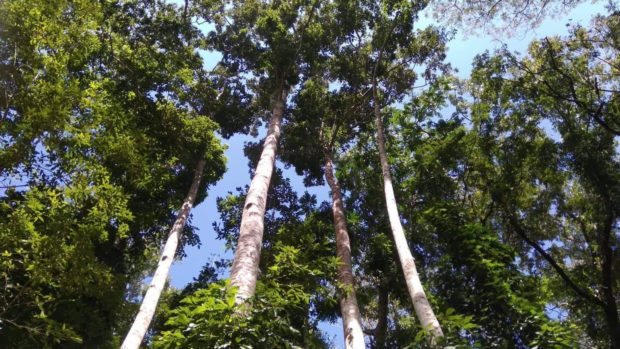
Dipterocarp or lowland rainforest trees, such as these in Mt. Makiling in Laguna, are essential, not just for the economical value, but for their ecosystem services and cultural value. Photo courtesy of Ma. Rovelyn D. Tumaneng and Roven D. Tumaneng.
MANILA, Philippines — Climate change adversely affects certain species of Philippine hardwood trees, such as yakal, apitong and tanguile, as the warming planet continues to make particular areas unsuitable for their growth, according to species distribution models created by scientists from the National University of Singapore.
In a study published in the journal Scientific Reports, the researchers also discovered that the lowland forests suitable for these trees, also known as dipterocarps, fall largely outside the current delineations of the country’s protected areas network.
A critical tree family in the Philippines and in Southeast Asia, the dipterocarpacaea has over 600 species of mainly lowland forest trees and is considered a major component of tropical forests in the region.
Researchers looked at the distribution of 19 species of dipterocarps in the Philippines, including the yakal (Shorea astylosa), apitong (Dipterocarpus grandiflorus), guijo (Shorea guiso), hagakhak (Dipterocarpus validus) and white lauan (Shorea contorta). Many of these trees are already considered vulnerable, while some are critically endangered.
TECHNOLOGY
TECHNOLOGY
TECHNOLOGY
Using species distribution models, the scientists mapped the existing dipterocarp species across the country. Results showed that land cover correction, or correcting the maps to show areas suitable for the growth of the trees, has already reduced their distribution by a median of 67 percent. Those within protected areas, which are enshrined under a law, decreased by 37 percent.
Some of the greatest losses, the study noted, were in Southern Luzon and Northern Visayas.



