

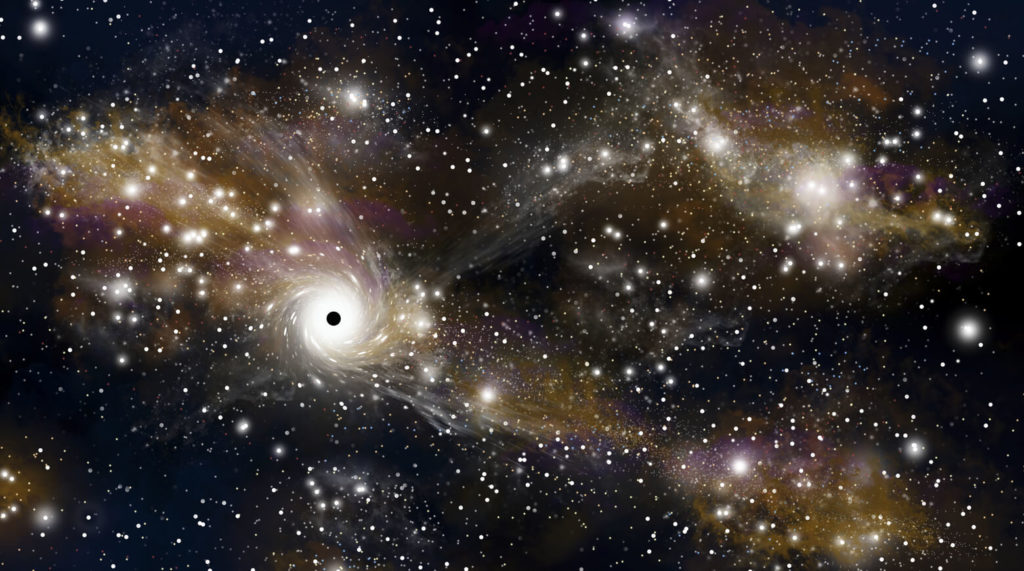

The supermassive black hole in question is located in the center of the Centaurus A galaxy about 12 million light years from Earth. Its mass is 55 million times that of the Sun. A photo from the Murchison Widefield Array telescope at the Observatory in Western Australia shows that the plasma ejected from the hole extends the length of about 16 moons, one next to the other. The plasma in these radioactive jets moves at close to the speed of light.

“These radioactive jets arise because material is sucked into a supermassive black hole at the center of the galaxy,” said astronomer Benjamin McKinley of Curtin University.

The astronomers’ study supports the theory that a model known as chaotic cold buildup exists.
“According to this model, clouds of cold gas condense in the galactic halo and rain down on central regions, feeding a supermassive black hole,” said astrophysicist Massimo Gaspari of Italy’s National Institute of Astrophysics.
Read more
The Very Bizarre Universe: Phenomena and Objects in Space That Are Hard to Imagine
Bill Gates called for a new industrial revolution to save the earth
Look at the electric truck of the future without a driver’s cab and with huge wheels at the back



