

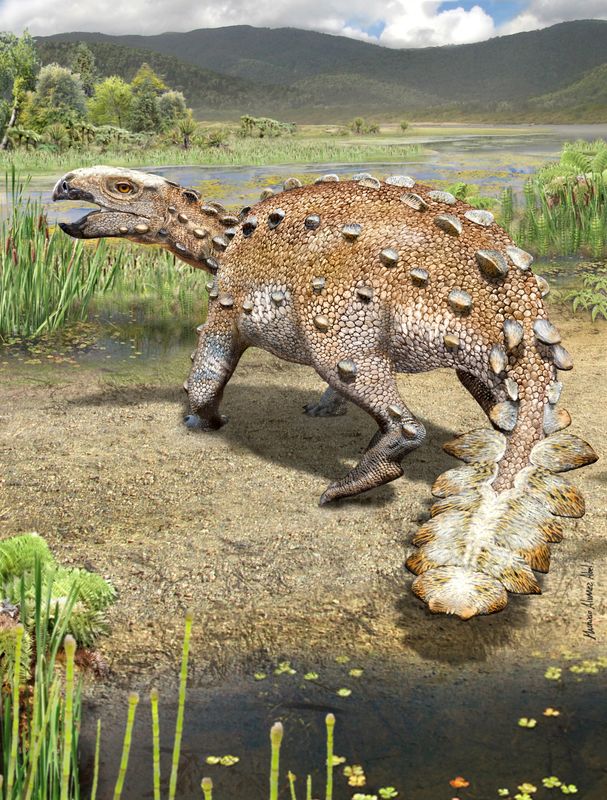
The newly identified Cretaceous Period armored dinosaur Stegouros elengassen, whose fossilized remains were discovered in Chile, is seen in an undated artist’s rendition. Courtesy of Mauricio Alvarez/Handout via REUTERS.
More than half a millennium ago, Aztec warriors brandished a weapon called a macuahuitl, a wooden club with jagged obsidian blades embedded on its sides, to inflict gruesome wounds on enemies in close combat.
A newly identified armored dinosaur that inhabited the Patagonian region of Chile did much the same thing to ward off predators about 74 million years ago with a tail resembling a macuahuitl, scientists said on Wednesday.
The four-legged plant-eating creature, named Stegouros elengassen, exemplifies the arms race that unfolded during the age of dinosaurs to acquire new traits to survive in a perilous world. It also sheds light on the evolution of a highly successful group of tank-like dinosaurs called ankylosaurs.
Stegouros lived in what is now South America’s southernmost tip during the Cretaceous Period in the twilight of the dinosaur era. It was small relative to other armored dinosaurs, at about 7 feet (2 meters) long. Stegouros possessed a beak-like mouth for cropping plants. Its back and sides were studded with bony structures called osteoderms that served as a coat of armor.
TECHNOLOGY
TECHNOLOGY
TECHNOLOGY
Its tail is utterly unique among dinosaurs. It is relatively short with fewer vertebrae than other armored dinosaurs. The tail’s back half is covered by a frond-like structure composed of seven pairs of flattened fused bony elements with craggy edges sticking outward.
“For now, we can only imagine how might Stegouros have used this weapon – and tail-swinging side to side as self-defense mechanism is a good guess,” said vertebrate paleontologist Sergio Soto, a University of Chile doctoral student and lead author of the study published in the journal Nature.



