

On Tuesday, November 30, Apple shares rose nearly 4% – while Microsoft, Google, Amazon and Meta fell. Pavel Gavrikov of BCS looks into the reasons.
Yesterday the sellers’ pressure was felt by many stocks. The widespread worries about a new strain of coronavirus and a statement of Federal Reserve Chairman Jerome Powell, who said that the regulator will be stepping down bond purchases.
Taken together, this led to a decline of 1.86% in Dow Jones index, 1.6% in NASDAQ and 1.9% in S&P 500. At the same time, Apple stock looked significantly better than the market – and here’s why.
Monetary and efficient bastion
Under the threat of an accelerated QE rollback, investors have begun looking for quiet coves to weather the storm. Apple has the wherewithal to provide that peace of mind – strong net income and solid free cash flow. Over the past 12 months, the company has earned about $95 billion in net income and generated $93 billion in FCF – more than the other tech giants.
Add to that Apple’s strong balance sheet – and you’ve got that quiet cove. Even during market downturns, the company is able to reward investors with steadily rising dividends and share buybacks. In terms of profitability, the company beats its closest competitors.
iInnovation
Many people criticize Apple for the same huge amount of money on its balance sheet that does not go to development. The devices are almost nothing different from year to year, the design changes only slightly, and so on. That’s partly true, but the current business model is proving to be effective – which is what investors appreciate.
The company is keeping up with the times, take the same 5G or ARM technologies. Moreover, Apple has some promising long-term initiatives: working on virtual and augmented reality projects, and creating unmanned cars.
Here’s the latest interesting news about the company:
Apple is preparing virtual reality glasses. According to rumors, they may be as powerful as Mac computers. According to the main analyst of TFI Asset Management Ming-Chi Kuo, glasses can go on sale at the end of the next year and will use their own chips on arm-technology.
Cowen analyst Krish Sankar said Tuesday that demand for the iPhone 13 in China is extremely high. Wedbush analyst Dan Ives added that judging by vendor and supply chain checks, domestic demand for the iPhone over Thanksgiving weekend was “robust.” He believes investors are viewing the stock as a “security blanket during this market turbulence.”
Technical picture
Yesterday, the stock was able to renew historic highs in the postmarket, opening up the possibility of a test of $168 support. Overcoming it opens the way to $172-175. Daily and weekly RSI just entered overbought area, so there is still room for upside.
On the technical side the stock is still overheated, so we shouldn’t rule out a correction soon, which is signaled by a descent under $160-156.8. Next, the road opens to the EMA50 test of $152. Such a move is not yet ruled out, but looks unwarranted given the uncertainty in the market.
What to do with Apple stock – forecast
Due to the coming technical overbought the current levels do not look attractive for long-term investing, but right now the stock is interesting for speculation. This may continue until there is certainty about Fed action and more relevant information about the omicron strain.
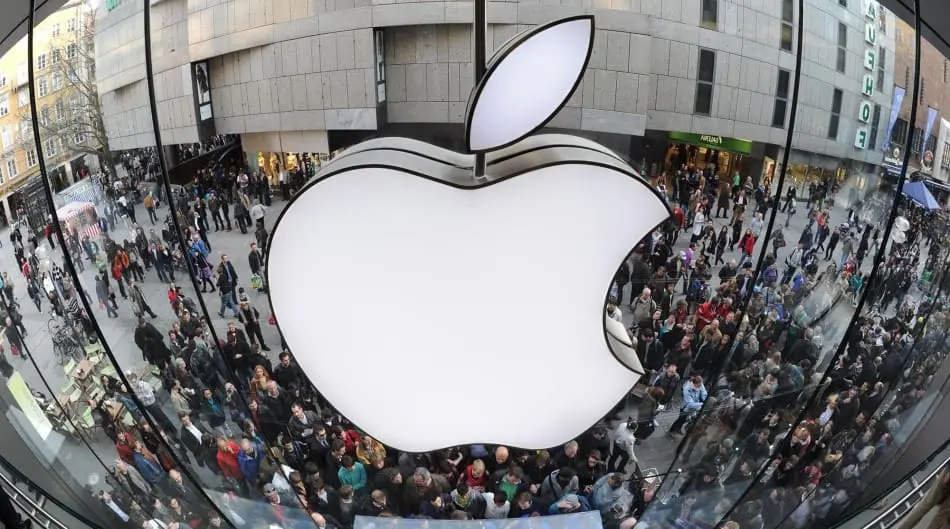
It’s not often in today’s world that you see a queue. Photo: Yandex Images The
long-term outlook remains moderately positive. After the correction, Apple stock is worth considering buying for the long term.
According to the WSJ, 25 of 41 analyst recommendations are to buy, 9 are to hold and none are to sell. Targets range from $128-198, and the average is $169.2 (+1.6%).
Since the beginning of the year, Apple stock has added about 25%. In terms of capitalization, the company remains the most expensive among the public at $2.7 trillion.



