

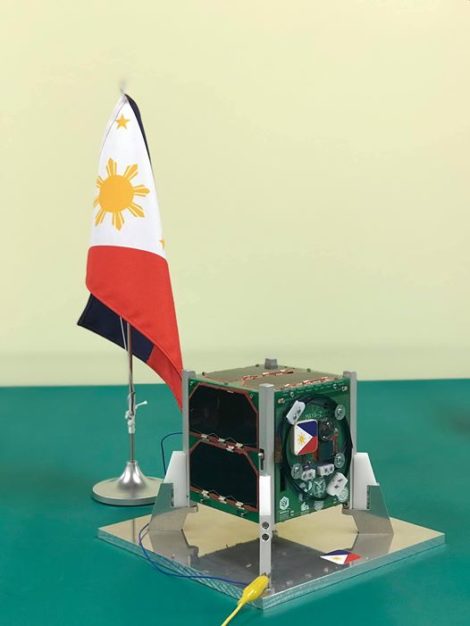
The Maya-2 Flight Model. Image: courtesy of BIRDS-4 Project
The second nanosatellite made by Filipino engineers was finally launched to space yesterday, Feb. 21.
The Maya-2 CubeSat took off on the Northrop Grumman CRS-15 mission at 1:36 a.m., Philippine Standard Time, the Department of Science and Technology – Science and Technology Information Institute (DOST-STII) said in a statement today, Feb. 22.
The spacecraft is en route to the International Space Station (ISS). After reaching the ISS, Maya-2 will be deployed to its targeted altitude in Low Earth Orbit.
The S.S. Katherine Johnson taking off. Image: screengrab via YouTube/NASA
“To do something for the first time is great, but to be able to do it again and innovate is greater,” said Philippine Space Agency (PhilSA) director general Joel Joseph S. Marciano Jr. “We take pride in the launch of Maya-2, the successor to Maya-1 and the Philippines’ latest milestone in creating value in space for and from Filipinos and for the world.”
TECHNOLOGY
TECHNOLOGY
TECHNOLOGY
Cube satellites are a cost-effective way to do more space research. Aside from the Filipino-made cube satellite, identical CubeSats from Paraguay and Japan were also part of the 8,000-pound cargo load of the uncrewed spacecraft called the S.S. Katherine Johnson. It was named in honor of the Black mathematician featured in the Oscar-nominated film “Hidden Figures.”
The BIRDS-4 CubeSats. (L-R) Maya-2 (Philippines), Tsuru (Japan), and GuaraniSat-1 (Paraguay). Image: courtesy of BIRDS-4 Project.
Behind the Maya-2 are Izrael Zenar C. Bautista, Mark Angelo C. Purio and Marloun Sejera. All three are scholars at the Kyushu Institute of Technology (Kyutech), taking up doctoral degrees in space systems engineering and space engineering.



