

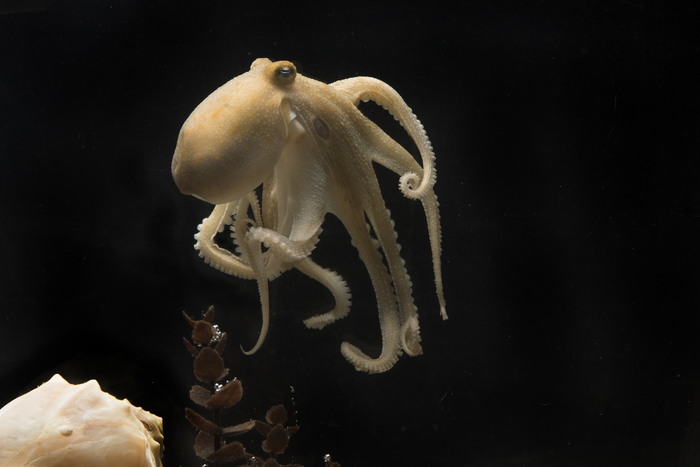

Many animal species die after reproduction. But with octopuses, it’s even worse. After they lay their eggs, the females leave the brood, stop eating, and begin to mutilate themselves. They can hit rocks, tear their own skin, even eat their own flesh. This leads to death. By the time the young octopus crawls out of the egg, its mother is already dead. A few months later, the male dies as well.
The short and grim life of octopuses has long intrigued scientists. In 1944, researchers hypothesized that mating somehow pushed the molecular “self-destruction” button within the sea creatures.
Nearly 80 years have passed, but this idea is finally taking shape. Scientists recently discovered that mating apparently alters several important biochemical pathways in female octopuses.
The unusual behavior has been linked to changes in cholesterol metabolism in the visual glands. It produces more 7-dehydrocholesterol as well as some steroid hormones and bile acids. These influence females to be more active in caring for their offspring, but at the same time force the octopus to harm itself.
In the study, scientists extracted the visual glands of adult female octopuses and studied them. It turned out that they produce two main types of signaling molecules: neuropeptides and steroid hormones. The problem is that after mating, the activity of those genes responsible for encoding neuropeptides decreases markedly. In turn, the genes that code for enzymes involved in steroid hormone synthesis are expressed much more strongly. Cholesterol-7-desaturase is one of these enzymes. It converts cholesterol to 7-dehydrocholesterol, which controls maturation and lifespan in many invertebrates.
Notably, in humans, a mutation that causes elevated levels of 7-dehydrocholesterol causes Smith-Lemley-Opitz syndrome. Recall, this is an autosomal recessive disease associated with metabolic disorders. The biochemical basis of this disease is a disorder of cholesterol synthesis caused by insufficient activity or absence of the 7-dehydrocholesterol reductase enzyme. People with this mutation often injure themselves, and it is very similar to the behavior of a female octopus, which has puzzled scientists.
By conducting additional research, scientists found that after mating, the metabolism of cholesterol and its constituents, such as 7-dehydrocholesterol, changes dramatically in the visual glands of female octopuses. It is likely that its high levels are inherently toxic not only to humans, but also to octopuses. They probably lead to the production of signaling factors that kill the mollusks, triggering a mode of
Read more
How dark matter “communicates” with the stuff we’re made of. Highlights of a new study
Fecal transplant can reverse aging
Compare how NASA and Roscosmos filmed the eclipse of the moon



