

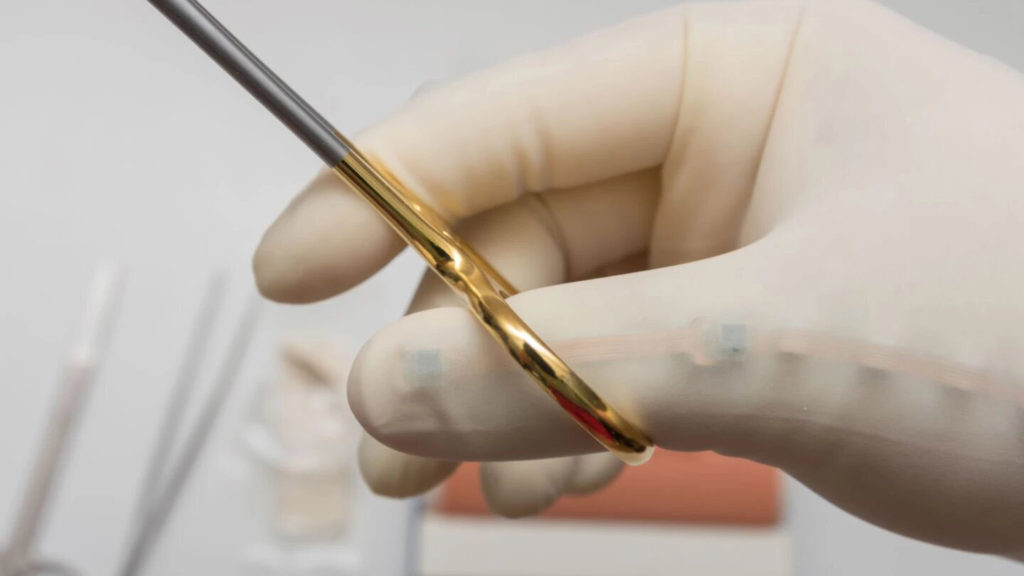

At the level of each phalanx of the index and middle finger, the glove has an inertial measurement unit, a special motion-tracking sensor. All units are connected by a flexible, flat electrical cable. The data collected by the sensors is sent to a smartphone using a Bluetooth transmitter.
This system records hand movements in the smallest detail. Trainees and their mentors get useful data to assess and improve performance during complex surgical procedures.
“Recording movements by itself is not enough,” notes Gough Louis, one of the system’s developers. – “Our approach is based on creating a catalog of records of experienced surgeons who have performed the same manipulation.
Based on a comparison of the student’s actions with the catalog of records, the mobile app tells them about errors and generates recommendations.
“Although surgical techniques have advanced significantly over the last century, training still relies heavily on observation. Mentors look over the trainees’ shoulder to evaluate their work,” Louis says.
Developers point out that full training simulators tend to be expensive. So not all medical and educational centers can afford them. The low cost of the sensors makes the technology available for use in various hospitals and educational institutions.
Read more
“James Webb” took the clearest photo of a star in history
“The Fifth Element” exists: new experiment will confirm that information is material
Take a look at the highest-quality picture of the Sun: it’s made up of 83 million pixels



