A reader of mine asks about my opinion regarding this universal life policy that he came across from AIA. Usually, I decide whether it makes some sense for me to write about it.
But since universal life is an area that I tackled less at work, but its uniquely popular among the higher net worth investors, I decided to do a dive into it.
This article goes into how a policy like AIA Platinum Legacy (IX) fit into your financial plan, when do you need it, how is its coverage and what is appealing about the policy.
You might learn a little how I think about legacy planning and may influence how you look at things.
This is not sponsored. Views are of my own.
What Kind of Policy is the AIA Platinum Legacy?
Per the brochure of AIA Platinum Legacy, the policy is a traditional universal life policy.
The policy aims to cover the whole of your life so that in the event that you passed away, there will be a death benefit for your heirs to get access to.
In AIA’s eyes, the policy will allow you to meet different needs, including legacy planning, estate liquidity, portfolio diversification and business continuity.
Generally, you can evaluate this policy through the lens of a traditional universal life policy.
However, do you know what is the role of a traditional universal life policy?
How Universal Life Feature in Your Estate & Legacy Planning
My observation is that many bought insurance plans without a clear idea about the role of that policy in their overall financial plan.
Or that they don’t even have an overall financial plan in the first place.
There is also a possibility that they were briefed by their planner but cannot remember what role the policy played.
The insurance policy usually comes in all sorts of fancy names such as Platinum Legacy but for many, they struggled to pigeonhole the policy to any roles.
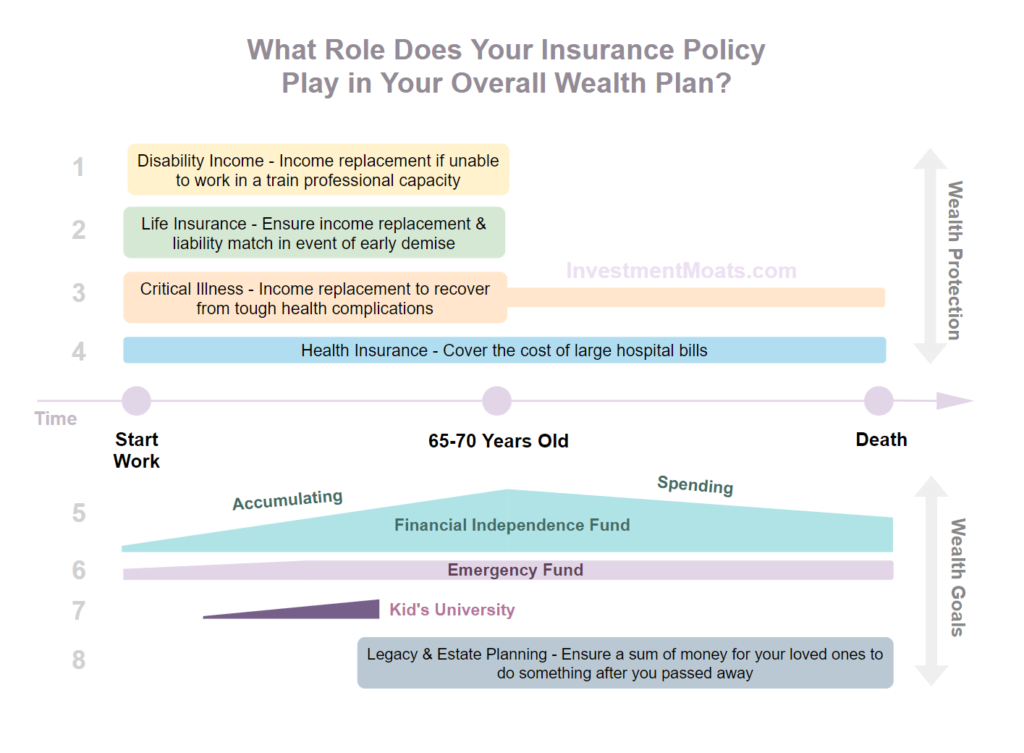
The following diagram may give you some guidelines on how to relate a particular insurance policy you were recommended to your overall financial plan:
Policies that provide Wealth Protection: Some insurance policies typically provide protection to ensure that in the event of unforeseen medical situations or disasters, there is a sum of money paid out, sometimes in lumpsum, sometimes overtime to alleviate the aftereffects of those situations.
Policies that help fulfil your Wealth Goals: For most of us, we have numerous life goals that we need to accumulate for. These can be your financial independence, saving for emergency fund, children’s education as well as having a bequest for our loved ones to help them when we are not around. Insurance companies have policies specifically to help tackle these goals.
Your policy should be able to pigeonhole into one or more than one of these areas. If you are able to visualize them well, you maybe able to know whether you have:
- Funded the wealth goals or provide enough protection
- How much is your shortfall
Also you would notice that each of those wealth protection is not technically needed throughout your life, or that they are needed at certain periods of your life. Similarily, some of your wealth goals are short term, some are long term. Some you will need them in earlier phases of your life, some later.
A universal life policy like AIA Platinum Legacy is meant less for wealth protection but specially to address one of your wealth goals.
And universal life are usually what you will consider only after you have funded other wealth goals that are higher in priority.
Some of you have already taken care of your financial independence, children’s education and saving for an emergency fund but you have a very strong urge to leave a fixed sum of money for your heirs to help them next time.
This is on top of your retirement or financial independence goals and university education.
If your views on leaving some assets to them is so strong, you should really carve this out as a separate legacy goal so that you can track it better.
If the urge is not so strong, technically, your heirs can distribute whatever that is left from the portfolio meant for your financial independence, as express in your will.
One of the reasons many feel like they need a uniform amount of money to help “equalize” the division of assets to their children. This diagram from AIA perfectly illustrates it:

Different assets are willed to different children, but their value may be different. The death benefit from the universal life policy provides the liquidity to equalize the distribution.
But I always thought that if the value of your policy is fixed, the value of the other assets are not fixed, so how does the person know exactly how much he needs? Your assets value changes over time, at different volatility. So how do you plan several years before your death?
A good question to ask to your financial planners.
How Does the AIA Platinum Legacy (IX) Work?
The diagram below tries to illustrate how the plan work:

The policyholder will pay an initial lumpsum premium of $192,000 in this case. If you do not wish to pay a lumpsum there is also a multipay option.
The universal life policy provides you with a minimum $1 million of coverage in this example (coverage will vary depending on your needs).
The duration and amount of coverage greatly depends on the crediting rate provided.
The crediting rate is like an “interest rate” provided by the insurance company as a return for holding the policy long term. To generate the return, the insurer will have to invest your premium in different asset classes. When you buy a universal life policy, you effectively transfer the investment management to the insurer, and take on a limited return as stipulated in the insurance contract. There is sometimes a minimum guaranteed crediting rate but generally crediting rate also contains a non-guaranteed portion.
We will look at the return in the other section.
The Platinum Legacy provided two coverage illustration: a more conservative coverage based on a guaranteed 1.5% crediting rate and a more optimistic coverage based on a non-guaranteed 8% creditng rate.
In the conservative coverage, the $1 million coverage will last till 80 years old and thereafter, if the policyholder passes away, there will be no more coverage.
In the optimistic coverage case, the coverage increases above $1 million at age 75 and can go as high as $2.1 million at age 80 and $9.2 million at age 100. To achieve this coverage, the crediting rate needs to perform at a crediting rate of 8% a year.
Thus, your legacy coverage heavily depends on the crediting rate, which depends on the insurer’s performance.
There are certain attributes that comes with the policy.
Guaranteed 8% a year Crediting Rate for First Three Years
As the title says. This adds up to 24%. The appeal of this may be that it offsets the initial 20% drop in policy value the moment you purchase the policy. (Usually, when you purchase a policy, a large part of the premiums goes towards paying the insurance company, the adviser and other costs so only a percentage is invested)
Guaranteed Special Bonus at Various Milestones

This is a small bump at various milestones.
How May the AIA Platinum Legacy Policy Value, Death Benefits Progress Over Time?
Now let us take a look at how the surrender value, accumulated policy value and the death benefit you enjoy changes as time progresses.
The table below is extracted from AIA Platinum Legacy (IX)’s benefit illustration:
 Click to view a larger table
Let me try to explain how to read the table.
The table illustrates how the surrender value, death benefit value and policy value changes over time, depending on whether you are accumulating on a guaranteed basis or non-guaranteed basis.
The guaranteed basis shows a very conservative scenario where you only earn the guaranteed crediting rate of 1.5% and max charges. The non-guaranteed basis shows a very optimistic scenario where on top of the guaranteed, you earn the maximum projected crediting rate.
In both guaranteed and non-guaranteed, we list 4 attributes:
- Cash Value if surrender: The amount you will receive if you surrender your policy
- Accumulation value: Sum of premiums paid + Interest from crediting rate earned – Charges
- Accumulation value growth rate: Change in accumulation value from previous year
- Death Benefit: The payout at death less any charges or annual withdrawal
Let us try to dissect the policy in detail.
Surrender value at the start
The policyholder paid $192,000 in premiums. Regardless of the returns, immediately in the first year, the surrender value is $155, 567.
This means that you are able to get back about 80% of your policy value.
In the conservative case where you only earn on a Guaranteed Basis, you never broke even on your policy and the growth rate is negative
If we focus on the Guaranteed Basis, you would notice that based on the projection, the accumulated value or cash value never crossed the premium of $192,000 you paid initially.
This is inclusive of the guaranteed 3 years of 8% crediting rate on the initial premium.
The growth of the accumulated value is also negative.
I attribute this to the potential charges of the policy and the low growth rate not being able to offset the charges. That is before we even talk about growth, the policy cannot keep afloat.
This more or less means that if you wish to gain a favourable outcome, from the investment perspective, the crediting rate will have to be higher than the guaranteed.
In the conservative case where you only earn on a Guaranteed Basis, the Death Benefit ends at 80 Years Old
From the illustration, it seems that the death benefit will stop at 80 years old or 35 years after the start of the policy. I am sure that if you wish to cover to 100 years old, this could be possible.
It would mean higher insurance charges.
After 80 years old, if the policyholder passes away, there will be no more cash value for his or her heir.
This more or less means that in order for the policy to extend well beyond 100, the investments that deliver the non-guaranteed crediting rate needs to do decently well.
In the optimistic case, the death benefit value can reach $10 million at 100 years old!
Now let us look at the Non-Guaranteed Basis section. Notice that the accumulated value growth rate starts off at 4.5% before reaching a terminal growth rate of 8%.
Between this period, we can see an occasional spike in growth due to the special bonus at 10, 15, 20 and 30th year.
Only the first 3 years of 8% credit rate is guaranteed but even during the first three years, the growth rate is much less than 8%. Most likely, this is due to the smaller premium base that the 8% is applied on (due to the commission charges and other charges taken out).
8% a year growth… is an optimistic growth rate and if you are serious about the policy, you may want to find out from your adviser just what do they put your money into.
The crediting rate that we usually see for a traditional universal life policy is in the range of 3-4%. This is way higher than normal and with this kind of returns expectation either means:
- A large allocation of the underlying investments towards higher risk asset classes such as equity
- Using a very optimistic projected growth rate of a more balanced portfolio during very optimistic times
The benefit illustration puts the illustrated yield or the internal rate of return to be 7.03% at the 8% crediting rate.
There is no right or wrong, but this is non-guaranteed and most likely it will anchor your brain to anticipate a lucrative surrender value or death benefit (which often will lead to disappointment if the growth fails to deliver).
 The second half of the table from 87 yrs old to 122 yrs old
The table above is a continuation of the previous table but from 87 years old to 122 years old.
Observe the power of compounding. If you are able to compound the policy at 8% a year, you can easily reach $10 million at 100 years old with only a capital of $192k.
The Projected Values Tell Us that the policy is under the Same Market Dynamics As Our Normal Investment Portfolios
Universal Life is meant less about investment performance, but we cannot ignore that investment performance is important for the policy to accumulate enough to reach our goal.
If we look at the range of projected values in the benefits illustration, you will realize that the policy is exposed to the same market forces as the investment portfolios made up of stocks and shares.
Here is a summary of our findings, specifically about the surrender values:
- If the policy grows only at the guaranteed rate, the surrender value never hit the premiums paid, and the surrender value goes down over time.
- If the policy is able to grow at the non-guaranteed crediting rate of 8% over time, we will get vastly superiod surrender value.
A lot of policyholders looked to insurance policies to insulate them from market volatility and also to ensure that over the long run, their investments are not impaired.
In the worst case, this policy is less than the principal sum and in the best case, it grows very well. Doesn’t that sound like your normal unit trust or ETF portfolio?
The only difference is that you will be able to see your unit trust or ETF portfolio value clearer and the volatility may be something that will affect you. The policy’s crediting rate will be volatile but unless you consistently ask for a new update on your policy value almost every day, you are less likely to feel the volatility.
Ultimately, the AIA Platinum Legacy do not look as much better than our traditional stocks and bonds portfolio, when viewed from the investment lens, unless the manager behind the investments is very good over the long run.
The Cost of the AIA Platinum Legacy Policy
There are various costs associated with the universal life policy.
The Premium Charge – What the Insurance Company Earns

You can find the premium charge in the benefits illustration of the policy. The premium charge is a fancy term to give everyone an estimation how much the insurance company earns. The insurance company then pays a subset of this to the advisory firm, which in turn shares that subset with the adviser. This amount will be split differently depending on how the advisory firm is structured.
If we use an initial premium of $192,000, 6% charge on that is $11,520.
Administration and Early Surrender Charges


The surrender charges forces people to be in the policy but it is also a way for the firm to profit from the policyholders who did not plan their cash flow soundly.
Insurance Risk Charge
While the policy is meant more for legacy, the policy does make use of an insurance component to guarantee that $1 million coverage.
Just like your basic term policy, the insurance cost depends on your very own health circumstances and whether the insurance company is willing to bear the risk.

My Thoughts About The AIA Platinum Legacy Policy
Like most plans, the most important thing is to firstly find out where it fits into your plan. Don’t buy a policy just because it sounds appealing and forcing yourself to buy the plan.
There are two big appeal of the universal life policy:
- The guaranteed 8% for the first three years
- The non-guaranteed crediting rate of 8% throughout the policy
The first one is appealing because its an automatic win. However, that is only if you are comparing against an equivalent universal life packaged solution. This 24% makes up for the drop in value in the initial years. If we compare against a normal investment portfolio, then this upside may not be too much.
What will attract many of you would be the non-guaranteed death benefit and surrender value based on the 8% crediting rate.
Your question should be:
- What is the investment basis to achieve the 8% crediting rate?
- How possible is it for the insurance company to achieve that?
8% is not impossible.
For illustration, a Dimensional US Small Cap Value Index (honestly I don’t want to use this but the MSCI version but somehow I cannot find it in my data provider) does 13.39% a year from the data range of 1926 to 2022. If we look at 20-year rolling returns, the best 20-year compounded growth was 23.3% a year (Jan 1975 to Dec 1984) and the worse is 4.2% a year (Mar 1929 to Feb 1948).
There are some astoundingly good years and in the worse case, the returns can be decent.
So what is the basis of 8%? I think you can try to ask but you may not get the answer.
Then the question to ask is, if the reason you want to purchase a universal life policy such as the AIA Platinum Legacy is to have predictability over your legacy needs, what if the value of the policy is also not very predictable (unless the 8% crediting rate is very very stable)?
Then why not just do the DIY solution? Some questions to ponder over.
Do you have a universal life policy that you came across that does better than this? Share with me here.
—
I invested in a diversified portfolio of exchange-traded funds (ETF) and stocks listed in the US, Hong Kong and London.
My preferred broker to trade and custodize my investments is Interactive Brokers. Interactive Brokers allow you to trade in the US, UK, Europe, Singapore, Hong Kong and many other markets. Options as well. There are no minimum monthly charges, very low forex fees for currency exchange, very low commissions for various markets.
To find out more visit Interactive Brokers today.
Join the Investment Moats Telegram channel here. I will share the materials, research, investment data, deals that I come across that enable me to run Investment Moats.

Do Like Me on Facebook. I share some tidbits that are not on the blog post there often. You can also choose to subscribe to my content via the email below.
I break down my resources according to these topics:
- Building Your Wealth Foundation – If you know and apply these simple financial concepts, your long term wealth should be pretty well managed. Find out what they are
- Active Investing – For active stock investors. My deeper thoughts from my stock investing experience
- Learning about REITs – My Free “Course” on REIT Investing for Beginners and Seasoned Investors
- Dividend Stock Tracker – Track all the common 4-10% yielding dividend stocks in SG
- Free Stock Portfolio Tracking Google Sheets that many love
- Retirement Planning, Financial Independence and Spending down money – My deep dive into how much you need to achieve these, and the different ways you can be financially free
- Providend – Where I currently work doing research. Fee-Only Advisory. No Commissions. Financial Independence Advisers and Retirement Specialists. No charge for the first meeting to understand how it works
The post AIA Platinum Legacy (IX) – The Universal Life with an 8% Crediting Rate appeared first on Investment Moats.