


The developers have created a fully automated system that learns through normal use and thus adapts to changing conditions.
“In this system, the user and the system simultaneously learn from each other. This has the potential to improve the usability and reliability of robotic prostheses,” Yeng says.
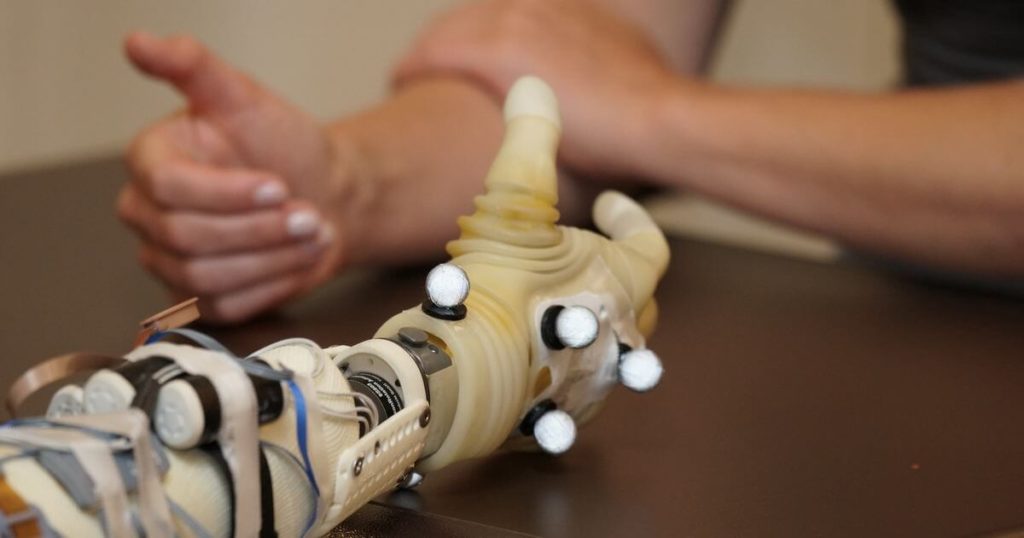
The results of the study, published in IEEE Transactions on Biomedical Engineering, were tested in a virtual environment. They were compared with currently existing systems. After successful tests, the research team conducted experiments with a user interface and a state-of-the-art prosthesis at Imperial College London. The developers asked a person with an amputated limb to move clothespins: such tests are widely used by physiotherapists to assess the function of upper limbs.
 A state-of-the-art prosthetic arm controlled by muscle activation. Aalto University.
The functionality of the system has been studied using controlled and standardized tests, but user needs are best determined by qualitative longitudinal studies.
“For future development, continued collaboration with medical centers and prosthesis users is very important,” says Jeng.
People who have had an upper limb amputated can operate a robotic prosthesis by contracting the remaining muscles. The connection in which the prosthesis picks up the electrical signals produced by the muscle is known as a myoelectric interface. The most advanced prostheses use machine learning algorithms to help interpret these user-generated signals. However, these connections are often very sensitive to external factors, such as perspiration, and weaken over time. To address this problem, the research community offers a variety of algorithms that can better adapt to changing circumstances.
Read more:
Scientists have found the healthiest people on Earth: It’s all about unique lifestyles
The dangers of free VPNs. Why they should not be downloaded and how to protect yourself?
Physicists recreated T-1000 abilities from “Terminator 2” in lab



