

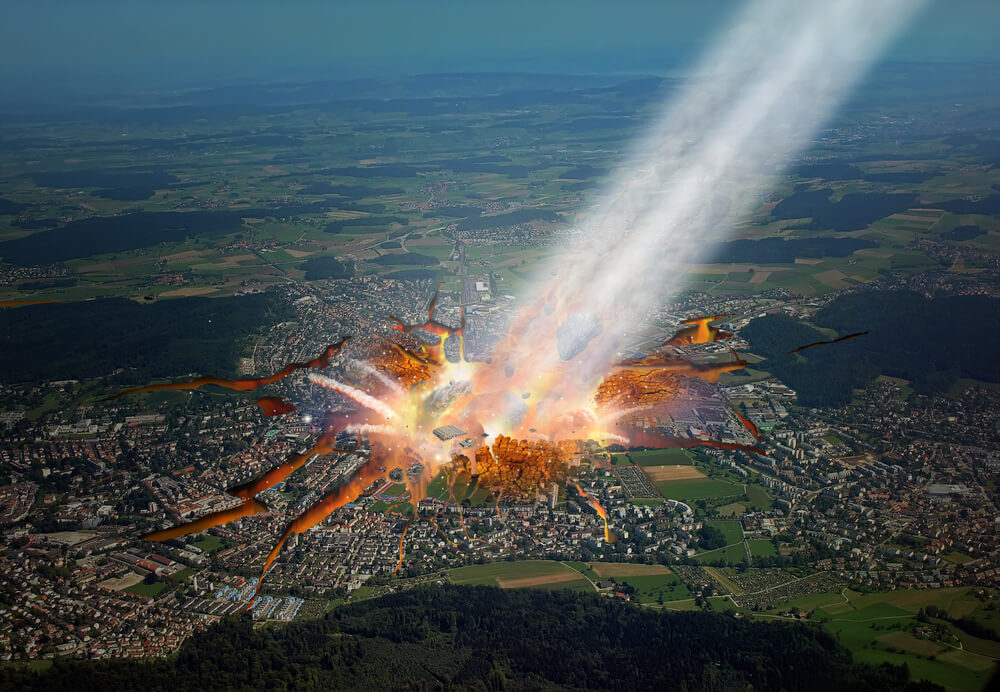

Professor Philip Lubin of the University of California, Santa Barbara, has developed a project to protect the Earth from asteroids. It is called PI-Terminal Defense for Humanity, where PI stands for Pulverize It. As Universe Today notes, Lubin believes that shredding an approaching asteroid into small pieces is the best way to protect yourself from it in the shortest possible time.
Lubin presented his PI Planetary Defense idea at the 2021 Planetary Defense Conference. Now his idea has now passed the first phase of NASA’s Innovative Advanced Concepts (NIAC, NASA’s Institute for Advanced Concepts) program. NIAC’s goal is to promote and support visionary ideas that will change future NASA missions.
 In the Pulverize It scenario, an asteroid headed toward Earth will be struck by an impactor consisting of an array of rods, some of which contain explosives. Authors and rights: Lubin/Experimental Cosmology Group, UCSB
The threat of collision with an asteroid is real. A huge asteroid, like the one that wiped out the dinosaurs, would destroy our civilization as well. “So far, humanity has avoided the large-scale catastrophe that struck the planet millions of years ago, but counting on luck is a bad strategy in the long run,” said Philip Lubin.
The idea behind Pulverize It is to develop an impactor that is not only kinetic, but also explosive. The impactor would be equipped with penetrating rods to penetrate the asteroid. They will contain explosives. As a result, the bolide will disintegrate into smaller pieces, such as 15 meters in diameter or smaller. Most of the debris would be destroyed by friction with Earth’s atmosphere. Launching a large explosive impactor from Earth will eventually become possible due to the development of SpaceX’s Falcon Heavy and NASA’s Space Launch System, the scientist notes.
The PI system requires a five-hour window before impact to destroy an asteroid the size of the Tunguska event object. This object was probably about 50 meters in diameter and exploded with a force of about 10 megatons. It fell millions of trees in a remote part of Siberia. If a space rock of this size exploded over a residential city, it would be devastating. All this would save the planet from an asteroid “at the very last moment,” concludes the author of the project.
Read more
Humanity’s largest genealogical tree reveals the history of our species
Environmentally friendly carbon dioxide fuel developed
The Great Pyramid of Cheops will be studied using cosmic rays



