

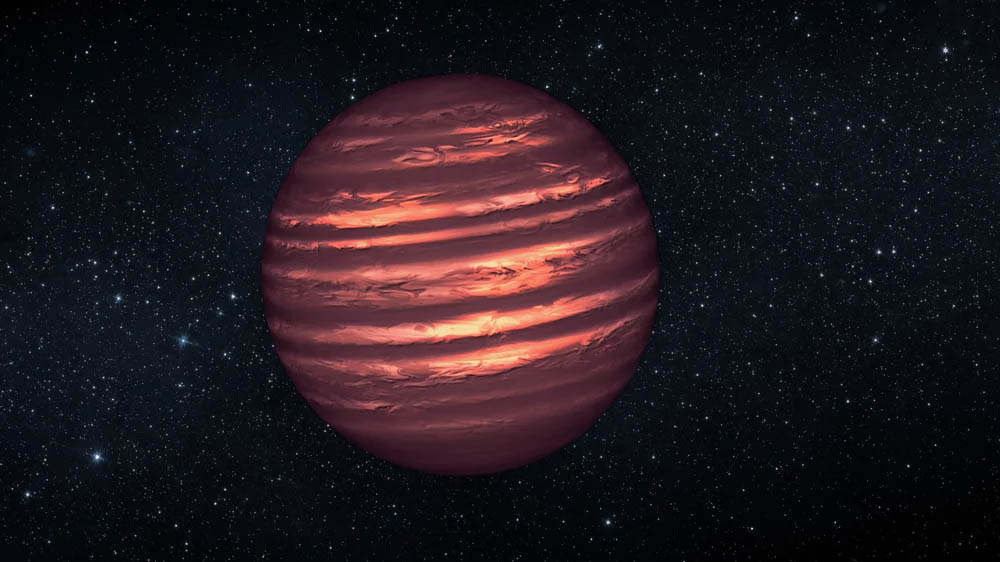

Scientists recently discovered a brown dwarf called TOI-2119b. It is the size of Jupiter, but more than 60 times more massive than the largest planet in the solar system.
Brown dwarfs are intermediate objects between planets and stars with masses between 13 and 80 Jupiters, also known as substars. Although many brown dwarfs have been discovered to date, it is rare for these objects to orbit other stars. The new pair of star and substar is only the ninth such system.
A team of astronomers led by Theron W. Carmichael of the University of Edinburgh used the Transiting Exoplanet Survey Satellite (TESS) to observe an active M-class dwarf. It is half the size and mass of the Sun. This object, known as TOI-2119, which is about 103.7 light-years from Earth. Scientists detected a transit signal on the light curve of this star. Subsequent studies confirmed that its source was a brown dwarf, which was named TOI-2119b.
TOI-2119b has a radius nearly the same as Jupiter (R1.08) and an estimated mass of 64.4 gas giants. It orbits its star every 7.2 days at a distance of about 0.06 AU from its star. The brown dwarf’s orbit has an eccentricity of 0.337 and is tilted 88.4 degrees. The calculated effective temperature of this object was 2,030 Kelvin (1,757 °C).
The parent star TOI-2119 is about half the size and mass of our Sun. It is estimated to be about 2.14 billion years old and has an effective temperature of 3,621 K (3,348 °C). The astronomers added that this discovery makes TOI-2119 one of the most active M dwarfs with a transiting brown dwarf among them.
Read more
Humanity’s largest genealogical tree revealed the history of our species
Physicists recreated T-1000 abilities from ‘Terminator 2’ in lab
Scientists may have found the missing link between single-cells and human cells



