

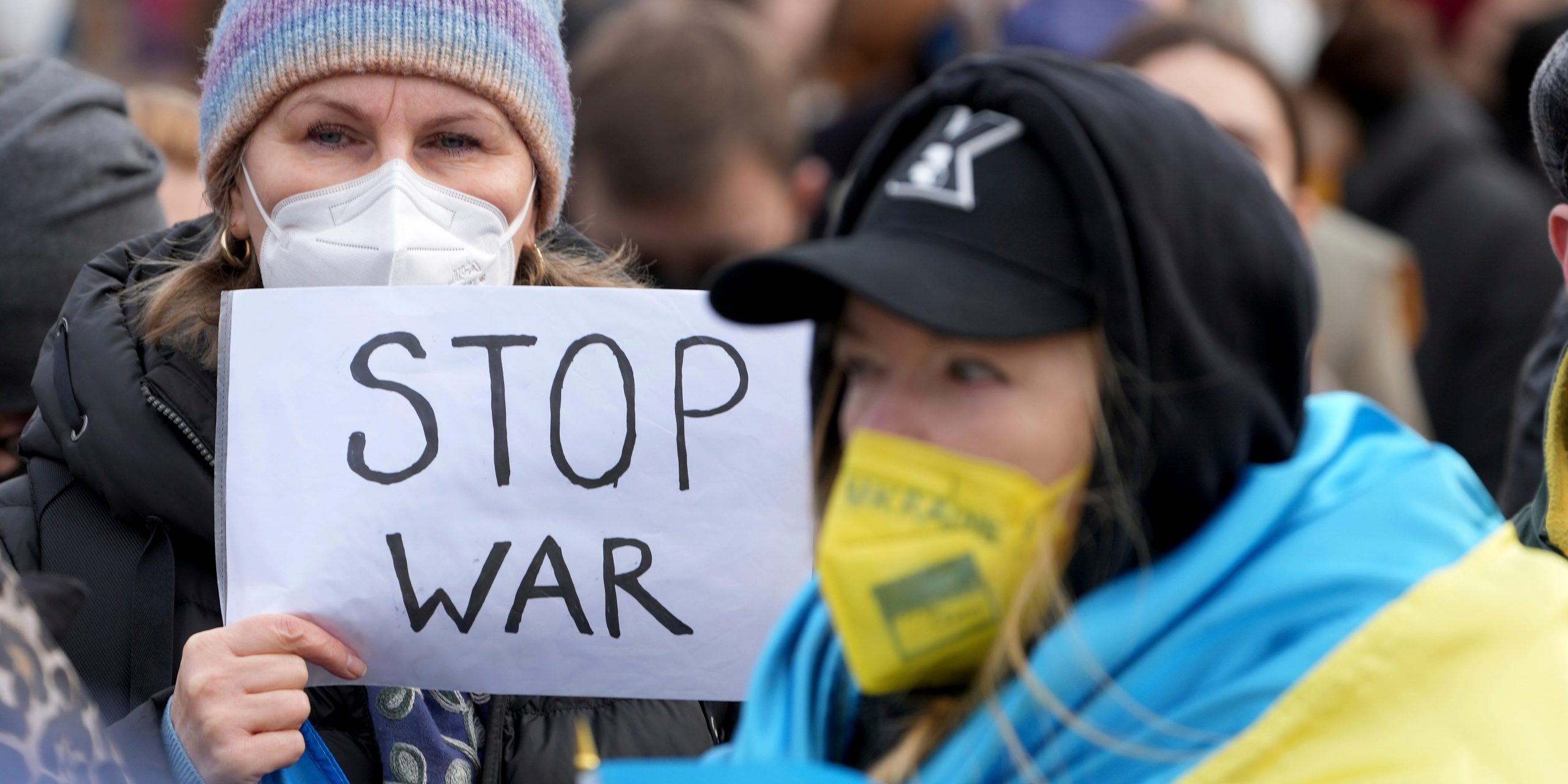
People attend a pro-Ukraine protest rally in front of the Brandenburg Gate in Berlin, Germany, Thursday, Feb. 24, 2022 after Russian troops have launched their anticipated attack on Ukraine.
AP Photo/Michael Sohn
- The US and NATO pledged Thursday to protect “every inch of NATO territory” amid Russia’s assault on Ukraine.
- Ukraine has expressed interest in joining the alliance but has never been formally admitted.
- Some of its neighbors, however, are longstanding members of the organization.
After weeks of tense escalation at Ukraine’s borders, Russian President Vladimir Putin on Thursday morning authorized a full-scale attack on the country.
In the hours that followed, explosions erupted cities across Ukraine — hundreds of miles from the previous conflict zone in the east of the country. Ukrainian officials have reported fighting on its borders with Russia, and dozens of casualties.
President Joe Biden said Thursday that no US troops would be sent to Ukraine, which is not a member of NATO, but warned that the US and its allies will “defend every inch of NATO territory.” The president also announced that some US troops will be sent to the Baltics to bolster NATO positions in the east.
“Our forces are not and will not be engaged in the conflict with Russia in Ukraine,” Biden said in a Thursday speech from the White House. “Our forces are not going to Europe to fight in Ukraine, but to defend our NATO allies.”
But as scores of Ukrainians flee to neighboring countries, the conflict has rapidly expanded into the most serious armed conflict in Europe for at least a decade.
What is NATO?
The North Atlantic Treaty Organization is a military alliance created in 1949 to provide collective security against Soviet expansionism and encourage European political integration in the aftermath of World War II.
NATO serves as a collective security system, wherein its member states agree to mutually defend any attack on a member party by any external actor.
The agreement included just 12 countries when it was founded but has nearly tripled in size in the years since. The alliance now includes 28 European countries and two countries in North America.
On Thursday, the organization condemned Russia’s “horrifying attack on Ukraine,” accusing Putin of violating international law in an act of aggression against an independent peaceful country. A statement from NATO said the organization has agreed to “take additional steps” to strengthen deterrence and protect all allies, but details on its next steps have been notably vague thus far.
“We stand united to defend each other,” the organization said in the statement.
And while NATO cemented its support for the Ukrainians killed and wounded in the conflict, the organization and its members have yet to offer any hint that they plan to directly intervene in Russia’s assault against Ukraine.
In his speech on Thursday, Putin warned that any Western nations choosing to become involved with his Ukrainian invasion would face “consequences greater than any you have faced in history.”
 Ukraine’s capital city Kyiv moments after Russian President Vladimir Putin authorized a military operation in eastern Ukraine
Reuters
Ukraine is not a member of NATO, but it wants to be
The former Soviet country has expressed a desire to join NATO but has yet to be formally admitted. The body has designated Ukraine, however, as one of its “enhanced opportunity partners,” a title granted to non-member countries that have contributed to NATO-led operations and missions.
But ongoing unrest in the country, even before 2022, worried some NATO members — such as France and Germany, who have both previously opposed Ukraine’s inclusion — and a new NATO member can only be inducted by unanimous consent.
Russian leaders — Putin in particular — have long been wary of NATO’s eastward expansion, especially after the alliance granted membership to former Soviet nations in the late 1990s and early 2000s. Tensions escalated even further in 2008 when NATO announced its intent to admit both Ukraine and Georgia at an undetermined future time.
Ukraine’s former Soviet status and close historic ties to Russia made potential NATO membership for the country a firm line in the sand for Putin, who said in 2008 that its inclusion in the alliance would be viewed as a “hostile act toward Russia.”
As such, NATO and its members have no legal obligation to act on Ukraine’s behalf.
But Ukrainian President Volodymyr Zelensky appealed directly to NATO members on Thursday following Russia’s invasion — a plea, he said, that was met with silence.
“Today I asked the 27 leaders of Europe whether Ukraine will be in NATO, I asked directly,” he said during a speech. “Everyone is afraid, does not answer. And we are not afraid, we are not afraid of anything.”
Belarus — Ukraine’s northern neighbor and a close Russian-ally — is not a member of NATO
Belarusian President Aleksandr Lukashenko, a longtime ally of Putin, allowed Russian forces to invade Ukraine on Thursday via Belarus.
While Lukashenko has claimed that Belarusian troops have not joined the conflict, Russian forces used Belarusian territory to enter Ukraine from the north, with Belarusian border guards and the country’s air defense system available to Moscow.
Lukashenko, dubbed “Europe’s last dictator,” said this week that his country’s forces will join the action “if it is necessary for Belarus and Russia.” Meanwhile, state-owned Russian news agency TASS reported Thursday that Lukashenko received assurances from Putin that any attack against Belarus would constitute an attack on Russia, as well.
Belarus is a member of the Collective Security Treaty Organization — Russia’s counter to NATO — which is its own intergovernmental military alliance in Eurasia that includes certain post-Soviet countries.
 The first train with Ukrainian refugees came to Przemysl, Poland on February 24, 2022.
Photo by Maciej Luczniewski/NurPhoto via Getty Images
Moldova has no plans to formally join NATO
In the immediate aftermath of Thursday’s invasion, thousands of Ukrainian refugees have already flocked to Moldova, located to the southwest of Ukraine.
The country’s president said the government has deployed temporary placement centers for incoming migrants and stressed that Moldova’s borders “are open for [Ukrainian] citizens who need safe transit or stay.”
But despite the small nation’s support for fleeing refugees, unlike Ukraine, the former Soviet country has no plans to formally join NATO.
Written into Moldova’s constitution is an enshrinement of neutrality: “The Republic of Moldova proclaims its permanent neutrality. The Republic of Moldova does not allow the deployment of armed forces of other states on its territory.”
The country does, however, cooperate with NATO on a range of issues, according to the alliance’s website, primarily in its efforts to reform and modernize its defense and security structures.
Poland has been part of NATO since 1999
Ukraine’s northwestern neighbor is becoming a key player in the ongoing conflict, as thousands of Ukrainian refugees seek solace in the NATO-protected, EU-nation.
The country was also the primary destination for more than 5,000 arriving US troops in eastern Europe leading up to Thursday’s invasion. On Thursday, Poland’s defense ministry introduced a high alert level, requiring soldiers in operational and territorial defense forces to stay in their units, The New York Times reported.
Poland, already home to more than 1 million Ukrainians, anticipates welcoming another million Ukrainians in the coming weeks in the wake of the Russian invasion. On Thursday, the country said it would open nine reception centers along its Ukrainian border in anticipation of more arrivals.
An analysis published in Foreign Policy speculated Thursday that Poland’s capital, Warsaw, is set to become “the linchpin of the West’s efforts to project power in Eastern Europe.”
Should Putin succeed in taking ultimate control of Ukraine, a new battle line in Central Europe would be drawn. Russian forces could be stationed along Poland’s eastern border, posing significant geopolitical ramifications and considerations for NATO countries, who have pledged to take action if one of their own is attacked.
 US soldiers are exercising at a hill in Arlamow military base. American soldiers arrived in Poland after Pentagon announced additional forces needed.
Photo by Attila Husejnow/SOPA Images/LightRocket via Getty Images
Ukraine’s three other western neighbors are members of NATO
Slovakia, Hungary, and Romania share a border with Ukraine and are all members of NATO.
Hungary joined the organization in 1999, while both Slovakia and Romania were granted membership in 2004.
All three countries have signaled that they are making preparations to accept incoming Ukrainian refugees.
Here is a full list of NATO members and the year they joined the organization:
- Albania: 2009
- Belgium: 1949
- Bulgaria: 2004
- Canada: 1949
- Croatia: 2009
- Czech Republic: 1999
- Denmark: 1949
- Estonia: 2004
- France: 1949
- Germany: 1955
- Greece: 1952
- Hungary: 1999
- Iceland: 1949
- Italy: 1949
- Latvia: 2004
- Lithuania: 2004
- Luxembourg: 1949
- Montenegro: 2017
- Netherlands: 1949
- North Macedonia: 2020
- Norway: 1949
- Poland: 1999
- Portugal: 1949
- Romania: 2004
- Slovakia: 2004
- Slovenia: 2004
- Spain: 1982
- Turkey: 1952
- United Kingdom: 1949
- United States: 1949
Read the original article on Business Insider 



