


Almost all of the stars that an observer can see in the sky with the naked eye are part of the Milky Way. Our galaxy is spiral shaped and stretches for 100,000 light years. It is home not only to Earth, but also to several other unusual objects. Scientists are constantly making discoveries about the Milky Way. We tell you about the most interesting ones.
What shape does the Milky Way really have?
Despite the popular belief that our galaxy is a flat disc, it’s not. Researchers have known since the mid-20th century that the Milky Way is curved and shaped like Pringles chips. Subsequent research has shown that this galactic curvature feature is common among other spiral galaxies as well.
 Warp of the spiral galaxy ESO 510-613. Source: NASA
What’s more, a study published in Nature suggests that the galaxy’s wavy shape was caused by its neighbors. We are talking about large and small Magellanic clouds – two dwarf galaxies orbiting the Milky Way. Scientists claim that they attract dark matter to our galaxy and cause it to warp.
The Milky Way is a cannibal galaxy
Galactic mergers are commonplace. Thus, the Milky Way is the product of past mergers, and in billions of years it will collide with the Andromeda galaxy.
Studying data from Gaia (Global Astrometric Interferometer for Astrophysics) of the European Space Agency (ESA), scientists found that there are two different sets of stars in the Milky Way. One set consists of “redder stars,” which are thought to have formed in a larger, metal-rich galaxy (“metal” in astronomical terms refers to any chemical elements heavier than hydrogen or helium), and the other set is “bluer stars,” which may have come from a smaller, metal-poor galaxy.
This evidence suggests that the Milky Way formed when it absorbed a smaller galaxy, Gaia Enceladus. Even now, it attracts stars from the dwarf spheroidal galaxies Big Dog and Sagittarius.
It has two huge cosmic bubbles.
The Fermi Gamma-ray Space Telescope was launched into space in June 2008 to make gamma-ray observations. Two years later, scientists used its data and discovered previously unknown giant spherical structures of gas and magnetic fields that emanate from the center of the Milky Way.
 Gamma Bubble discovered at the center of the Milky Way. Source: NASA Goddard Space Flight Center/Wikimedia Commons.
These structures extend 25,000 light-years above and below the plane of the galaxy. They were called Fermi Bubbles. Scientists from the Chinese Academy of Sciences later determined that these structures were caused by the activity of the Sagittarius A* black hole at the center of the galaxy.
There are many strange stars in the Milky Way
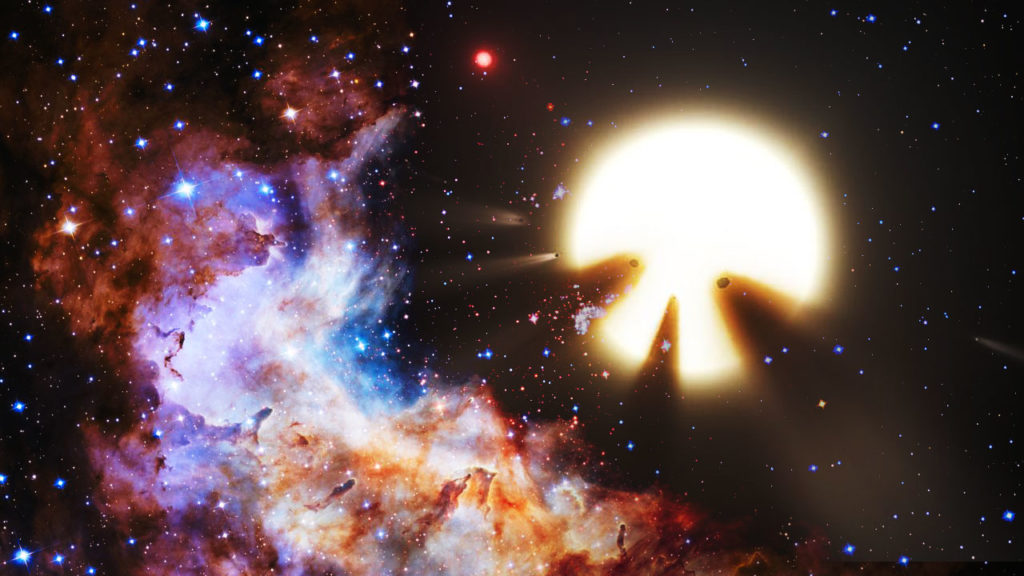
One of the most unusual objects observed by Kepler is the star Tabby (KIC 8462852). It is 1,200 light-years away in the constellation Swan and is about 1.4 times the mass of the Sun.
 Photo: NASA
This star surprised scientists by the fact that, for some unknown reason, it was only 20% luminous. Astronomers speculated that something was blocking it, and it was an object larger than a typical exoplanet. Scientists even speculated that it was an alien Dyson sphere (a hypothetical astroengineering project, a relatively thin spherical shell of large radius with a star in the center).
Subsequent observations, however, ruled out such a possibility. Scientists assumed that it was a dust field, although there are different arguments about its nature. Astronomers have not seen anything like it since.
Also in the Milky Way is the oldest star in the universe, HD 140283. However, according to some estimates, it may even be older than it is. While the universe is 13.8 billion years old, HD 140283 is estimated to be 14.4 billion years old. Scientists have long sought an explanation for this anomaly.
 Photos: DSS, STSCI/AURA, PALOMAR/CALTECH and UKSTU/AAO
Also in the Milky Way is Vega, a large, bright, young star relatively close to Earth. It appears to be normal, but it isn’t. It rotates at 274 km/sec. This is almost the maximum speed that a star like this can handle. In addition, it has an unusual shape – more like an egg, not round.
The Milky Way Galaxy is about 1,000,000,000,000,000,000 km across. Even traveling at the speed of light, it would take more than 100,000,000 years to get from one end of the galaxy to the other. Much about it is still unknown, but scientists are trying to learn more about it.
Read more
Jacket that can’t face the apocalypse: NASA and Air Force technology were used to create it
Man-made island found, thought to be 1 200 years old: thought to have formed naturally
Dogs can recognize their owners from a distance without using their sense of smell or sight



