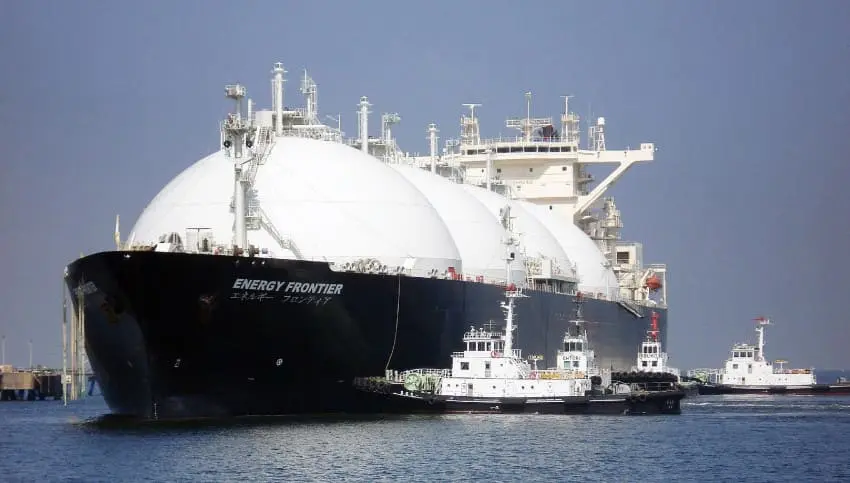
LNG shipments from the U.S. to Europe have increased markedly. This provoked discussions about the probable displacement of Russian volumes from the region. Prime magazine found out whether Gazprom’s top managers should take it to heart or not.
“Cowboy” pressure
Liquefied natural gas (LNG) supplies from the United States to the European region have increased sharply in recent days, contributing to the cheaper energy carrier in Europe, Vedomosti reported, citing the American business publication Bloomberg. On the basis of this assertion, the conclusion is offered that these volumes have begun to displace Russian gas from the local market.
It is pointed out that deliveries to terminals in northwest Europe have reached their highest since December 2019. At the same time, it is noted that they help offset “limited” exports from Russia: the record rise in the price of natural gas in Europe in December forced traders supplying LNG to Asia to divert tankers to European ports.
LNG supplies have increased
“At present,
LNG supplies to Europe have intensified,” agrees Ekaterina Krylova, chief analyst at Promsvyazbank, “as an opportunity for traders to “earn” money: on the one hand, demand in Asia is now sluggish against moderate temperatures and acceptable inventory levels, on the other hand, in Europe – critically low inventory levels plus forecast low temperatures, plus some reduction of pipe supplies from Russia”
. LNG supply from the US. Photo: Reuters
U.S. LNG did become more attractive to European customers in late December and early January, states Ekaterina Kolbikova, senior consultant at Vygon Consulting
.
“According to our estimates, the price including delivery to the region decreased from a record $350 per thousand cubic meters in November 2021 to $265 per thousand cubic meters at the moment, i.e. by 23%,” comments the expert. The fact is that at the end of December there was a noticeable reduction in the cost of gas in the U.S., and freight rates.
About: Gas prices are falling sharply in Europe and rising in the U.S.
”
The latter fell at all from about 240 to 60 thousand dollars a day,” – clarifies Kolbikova
.
Most of the gas sold under long-term contracts, both in Europe and in the Asia-Pacific region (APR), is priced three to four times cheaper than it is on the spot market, the specialist explains. This can be explained by formulas that provide for various time “lags” and averaging, and in some cases – by linking gas prices to oil prices.
“For example, the price of LNG with “oil” pegged is about 350-450 dollars per thousand cubic meters, and pipeline gas was in a similar range last fall,” says Kolbikova. – And only the demand in excess of the contractual obligations can be met on the term market, for Europe it is on average 15% of imports”.
But she sees the main reason for the reorientation of U.S. LNG supplies from Asia to the European market as the increased demand in Europe in mid-December and the emergence of a premium. “Today the situation is reversed,” the expert points out. – Premiums are again observed in Asia, in the amount of $150-200 per thousand cubic meters, and many exporters have already sent tankers there.
At the same time on January 3 Bloomberg reported about the appreciation of natural gas in Europe, which “once again” was caused by “uncertainty about the safety of supplies to Europe in the winter months,” arising from the “reduction of energy flows from Russia.
As a result, according to the publication, a key indicator of the European natural gas market, the price at the TTF hub for the next month, rose 20% to 84.50 euros per megawatt hour, after declining in the previous days. It then began falling again, which, according to ICE Futures, continued on January 11.
And a major warming in Europe over the New Year’s weekend led to a reduction in Russian gas supplies. Pumping through the Yamal-Europe pipeline has not resumed, through Ukraine has almost halved, and through Turkish Stream by a third.
Gazprom’s European clients, hoping for a warm winter, minimize their purchases and use volumes from the underground gas storages (UGS). However, their supply is behind the usual schedule, which also spurred the import of liquefied gas, says Kirill Rodionov, expert of the Institute of Fuel and Energy Technology Development (IRTTEK).
Where the scales will tip
”
If in 2019 European countries imported 18.4 billion cubic meters of natural gas in regasified equivalent from the United States, in 2020 – 26.7 billion cubic meters, and in 2021 – 31.1 billion cubic meters,” says Rodionov with reference to data from Refinitiv
.
IRTTEK specialists attribute the main role in this to the commissioning of new liquefaction capacities, in particular, the Corpus Christi plant in Texas with a total capacity of 15 million tons of LNG per year (20.7 billion cubic meters in regasified form): Cheniere put into operation its first two stages in February and August 2019, and the third – in March 2021.
“At the same time, U.S. companies will continue to increase production capacity this year,” the specialist continues. – Last November Cheniere also carried out a test run of the sixth stage of another LNG plant in Texas, Sabine Pass, with capacity of 7.8 billion cubic meters per year, and by the end of 2022 the Calcasieu Pass plant in Louisiana should reach the design capacity of 16.5 billion cubic meters.
However, according to Ekaterina Kolbikova from Vygon Consulting, it is not possible to speak about the possibility of systematic displacement of pipeline gas in Europe with liquefied gas in any case.
“Most contracts for the purchase of U.S. LNG are implemented on a fob basis in the Gulf of Mexico, that is, they are not tied to a specific destination country,” she notes. – In other words, buyers have no obligation to deliver US LNG specifically to the European region.”
And Igor Galaktionov, stock market expert at BCS World Investments, notes:
“By the end of 2020, Russian gas, mostly supplied by pipeline, accounted for about 40% of all European imports.”
At that, Gazprom’s supplies to far-abroad countries (first of all, to Europe) increased by 8.2 billion cubic meters in the period from the beginning of January to the middle of December last year against the same period in 2020.
On topic: Gas prices in Europe have exceeded $ 1100 per thousand cubic meters
“At the same time
the share of American LNG was only 5.5% of the total volume of energy imports to Europe”, the expert does not hide his skepticism
.
Thus, he concludes, Russia and the US, as natural gas suppliers to Europe, are in absolutely different weight categories in order to talk seriously about replacing Russian volumes with US volumes. “We can only talk about this in the long term, especially since LNG supplies have a number of disadvantages compared to pipeline gas,” Galaktionov believes.
Author: Oleg Krivoshapov