

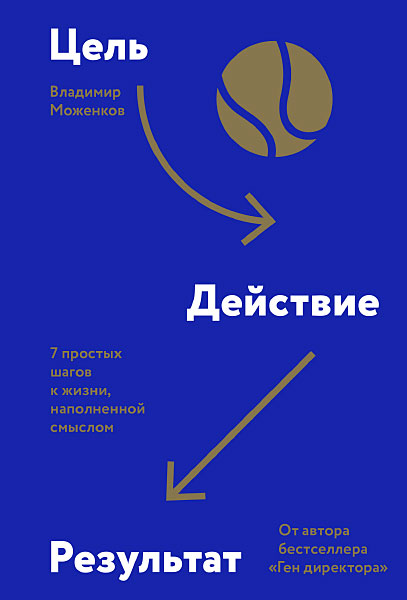
Life is like riding a bicycle: if you don’t move forward, you immediately fall. In his new book, “Goal-Action-Result,” Vladimir Mozhenkov tells how to set goals and overcome obstacles on the way to achieving them. He has included in this book personally tested techniques and methods.
Subscribe Subscribe You are subscribed Subscribe You are subscribed
Vladimir tells about a method that will help to move always forward
.
We tell you about it.
Goal-Action-Result
The
concept of “future me
”
The author of the concept was our contemporary, the American Trent Hamm. He deeply studies the subject of money, financial planning. In 2006 he founded The Simple Dollar and regularly publishes his own columns on personal finances there. In addition, he writes books and articles for leading media outlets, including The New York Times, Forbes and The Guardian.
Vladimir Mozhenkov is the founder of AvtoSpec-Center, Audi Center Taganka and the consulting company Mozhenkov Progress Consulting, a consultant, a business speaker, a business mentor, the founder of the club for managers and owners of the Mastermind Achievers, the best Audi manager in Europe according to Audi AG.
Hamm outlines the concept of the “future self.” As the name implies, this is your image of yourself in the future, but painted not in pink or black colors, but as realistically as possible.
The fact is that human beings as a species are tuned to think in the short term, looking for quick benefits. We inherited this from our ancestors who lived in constant danger: wild animals or enemies from a neighboring tribe threatened to attack at any moment. To survive, ancient people used to think about everyday life, to cope with difficulties here and now. Those who did, survived and passed on their genes.
Today we live in a different world, where there is no need to think only in the short term. But the brain continues to act that way by default – a legacy of centuries of programming.
Trent Hamm offers a tool to systematically, step by step, “rewire” and retrain the brain.
The author of the concept notes that the decisions you make today are shaping the life of the “future me”, even if it is not immediately apparent. For example, you didn’t spend the evening with your children, but sat on social networks: be kind enough to admit that relationships with children in adolescence and adulthood may deteriorate.
It would seem that it’s just one time, what’s to worry about! But it’s those “one-offs” that make up a life.
The same goes for a career, for example. If you get bogged down in routine work, if you have not done anything beyond routine work tasks today, then you will not gain the skills and reputation necessary to advance in your career. Brutal but true.
Three Principles
Hamm identifies three basic principles of “future self” thinking.
1. If something you’re doing today doesn’t have a long-term benefit, it’s probably not worth doing.
Remember the “short-term” brain? It’s the one that suggests you sit in front of the TV or scroll through your social media feed in the evening. And never mind that in the long run, it won’t bring you any benefits.
Don’t settle for such brain suggestions, get busy with something important and useful: take stock of the day, read a book.
2. Doing something with a long-term perspective doesn’t mean you have to be miserable today.
We all know that you should spend your money wisely. But when we hear about savings, the image of a miser often emerges in our heads, and inner resistance comes into play: I’m not going to eat instant noodles out of a sachet
…
No one is forcing me to. It is worth to think about it and choose the way of economizing. For example, not to take every day dessert at lunch time: both save money and avoid problems with excess weight in the long run.
Remember that even small decisions today can make a huge difference to the “future me”.
3. Constantly evaluate your choices.
Analyze what actions you take on a regular basis and evaluate their impact on you in the future. If it turns out that they don’t lead to progress, find a better use of your time, energy, or money.
Hamm acknowledges: the goal of future-me thinking is not to turn into the perfect person. That’s definitely not going to happen. The point of the concept is to have an image of yourself from the future in front of you, to understand what today’s decisions will get you there. This approach motivates you to set yourself ambitious goals and achieve them despite the challenges you face.
And what’s particularly gratifying is that by practicing “future me” thinking, we get used to making decisions with a long-term perspective, rather than chasing quick gains.
Try it: will Trent Hamm’s concept work well for you?
From Goal-Action-Result
Subscribe to book release We’ll email you when the Goal-Action-Result book goes on sale and give you a discount We’ll email {{ email }} when the Goal-Action-Result book goes on sale and give you a discount Subscribe You subscribe Subscribe You subscribe
Post Cover: unsplash.com
The post How to learn to make decisions with a long-term perspective
in mind.
The “future me” concept appeared first on Business.



