

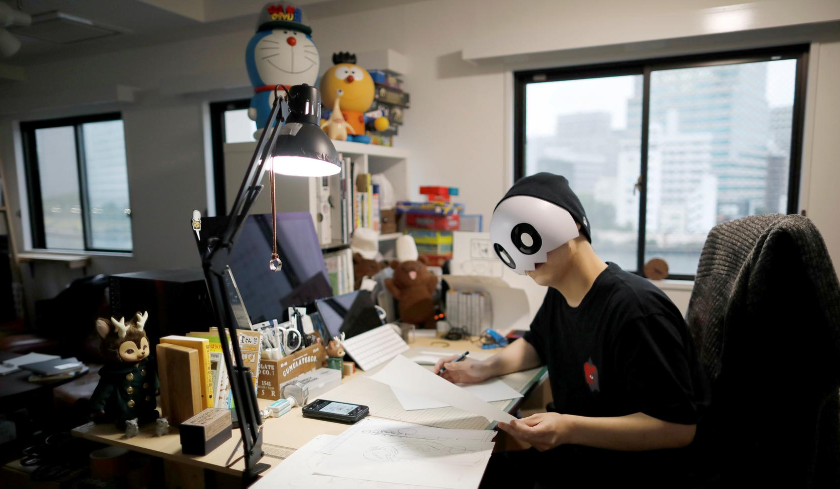
Japanese manga artist Kamentotsu, who goes by his pen name and wears a mask in media appearances, draws his four-panel strip comic ‘Koguma’s Cake Shop’ at his workspace in Tokyo, Japan October 8, 2020. REUTERS/Issei Kato
TOKYO — Manga artist Kamentotsu didn’t expect much when he uploaded a four-panel strip about an anthropomorphic bear who runs a cake shop to his Twitter account three years ago.
But the first installment of “Koguma’s Cake Shop,” drawn as consolation for a tired friend, attracted tens of thousands of likes. Within a week, 40 companies had approached him with offers.
“Publishing company editors have gone from bringing up manga artists, like they are farming, to hunting for them,” said Kamentotsu, who goes by his pen name and wears a mask in media appearances.
By searching for talent online, publishers squeezed by the rise of the internet can see an artist’s audience potential out in the open.
TECHNOLOGY
TECHNOLOGY
TECHNOLOGY
For Japan’s striving manga artists, many of whom toil in obscurity for low pay, that means going viral can be life changing.
Kamentotsu’s strip, which is published by Shogakukan, has gone on to sell more than half a million books. The titular bear, who wears a chef’s hat, has become a popular soft toy and its image was used to promote frozen dumplings.



